
You are publishing blog posts every week, running paid ads, staying active on social media, and still watching your leads trickle in without converting. If this sounds familiar, you are not alone – and the problem is rarely the quality of your content. The problem is almost always a missing framework. Most marketers create content in isolation, without asking the most important question: where is this person in their buying journey?
That is exactly where TOFU, MOFU, and BOFU come in. These three terms – Top of Funnel, Middle of Funnel, and Bottom of Funnel – describe the three distinct stages a potential customer moves through before making a purchase decision. When you understand what each stage means and what your audience needs at each one, you stop guessing and start building a content strategy that actually works.
This guide will walk you through each funnel stage in depth, explain what content belongs where, and show you real campaign examples from well-known brands so you can see the theory in action. By the end, you will have a clear mental model for planning campaigns that attract the right people, nurture them into qualified leads, and convert them into paying customers.
What Is the Marketing Funnel?
The marketing funnel is a model that maps the journey a person takes from first discovering your brand to eventually becoming a customer. It is called a funnel for a simple reason: a large number of people enter at the top, but only a fraction of them make it all the way to the bottom to complete a purchase. At each stage, some people drop off – they lose interest, find a competitor, or simply are not ready to buy yet.
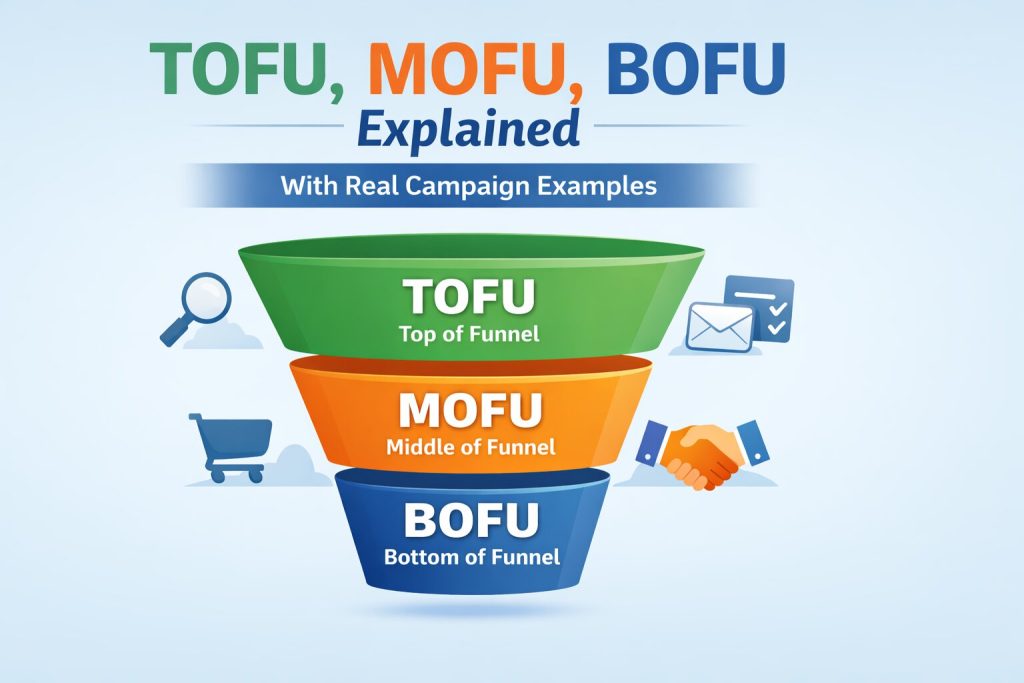
The traditional funnel has three layers. The top is wide and focused on awareness. The middle is where people evaluate their options and deepen their understanding. The bottom is where serious buyers make their final decisions. Understanding which layer a prospect is in at any given moment allows you to deliver exactly the right message at exactly the right time – and that alignment is what separates high-performing marketing teams from those that spin their wheels.
Here is a quick snapshot of what each stage represents before we dive deeper:
- TOFU (Top of Funnel) – Awareness stage. Your audience has a problem but may not know the solution yet.
- MOFU (Middle of Funnel) – Consideration stage. Your audience knows solutions exist and is actively evaluating options.
- BOFU (Bottom of Funnel) – Decision stage. Your audience is ready to buy and needs a final reason to choose you.
The power of this framework lies not in any single stage but in how the three stages connect. TOFU feeds MOFU, MOFU feeds BOFU, and BOFU produces customers. Skip or underinvest in any one stage and the whole system underperforms.
TOFU: Top of Funnel – Building Awareness
What Is TOFU?
Top of Funnel marketing is everything you do to make cold audiences aware that your brand exists. These are people who have a problem or a question – they might be searching Google for help, scrolling through social media, or watching YouTube videos – but they have little to no knowledge of your product or service. They are not shopping. They are learning.
This is the widest and most visible layer of your funnel. Your goal at the TOFU stage is not to sell anything. It is to be genuinely useful, to show up in the places where your target audience spends time, and to earn their attention and trust. Think of TOFU content as the first handshake. If you lead with a sales pitch, people walk away. If you lead with value, they lean in.
What Content Works at the TOFU Stage?
The best TOFU content is educational, entertaining, or inspirational – and it is optimized for the channels where your audience discovers new information. Search engine optimization plays a massive role here because most TOFU journeys begin with a question typed into Google. A blog post that answers a common question in your industry can attract thousands of cold visitors every month without a single rupee in ad spend.
Beyond organic search, TOFU content includes social media posts that stop the scroll, short-form videos that teach something useful, podcasts that explore industry topics, infographics that make complex data digestible, and awareness-level paid ads that introduce your brand to new audiences. The common thread running through all of these is that they prioritize the audience’s interest over the brand’s promotional goals.
The most effective TOFU content formats include:
- SEO blog posts and how-to guides targeting informational search keywords
- Short-form and long-form video content on YouTube, Instagram Reels, or LinkedIn
- Podcast episodes and guest appearances on industry shows
- Infographics and data visualizations shared on social media
- Brand awareness paid campaigns on Meta, Google Display, or YouTube
Real Campaign Example: HubSpot’s Free Blog Ideas Generator
One of the most brilliant TOFU campaigns in the marketing world is HubSpot’s free Blog Topic Generator tool. Rather than simply publishing articles about content marketing, HubSpot built an interactive tool that any blogger or marketer could use to generate blog topic ideas in seconds. Users typed in a few keywords and the tool spat out a week’s worth of headline suggestions.
The genius of this campaign was its selflessness. HubSpot gave away something genuinely useful to an audience of cold visitors who had never heard of their product. People searching for “blog post ideas” or “content strategy help” landed on this tool, experienced HubSpot’s brand as helpful and knowledgeable, and entered the funnel without ever feeling sold to. This is TOFU done right: attract with value, never with a pitch.
Real Campaign Example: Canva’s Design School YouTube Series
Canva – the design platform – built an entire YouTube series called Design School aimed at complete beginners. Videos like “How to Design a Logo from Scratch” and “Canva Tutorial for Beginners” targeted exactly the kind of searches that cold audiences type into YouTube every day. None of these videos were product demos. They were pure education.
By helping millions of people learn design basics, Canva built enormous brand affinity with an audience that had no prior relationship with them. When those viewers later needed a design tool, Canva was the obvious choice because the brand had already earned their trust. That is the long-term payoff of consistent, generous TOFU content.
Key Metrics to Track at the TOFU Stage
- Organic website traffic (new visitors specifically)
- Impressions and reach across social and paid channels
- Video views and average watch time
- Keyword rankings for informational search terms
- Brand search volume growth over time
MOFU: Middle of Funnel – Nurturing and Building Trust
What Is MOFU?
Middle of Funnel marketing is where relationships are built and leads are nurtured. The people in this stage already know they have a problem and they are actively looking for the best way to solve it. They have moved past the awareness stage and are now comparing solutions, evaluating options, and doing deeper research before committing to a purchase.
This is arguably the most underinvested stage in most marketing strategies. Brands pour budget into TOFU awareness campaigns and BOFU conversion ads, but neglect the middle – the critical bridge between interest and intent. When MOFU is weak, you end up with a leaky funnel: lots of traffic coming in at the top, very little making it to the bottom. The leads are there; they just were not nurtured enough to be ready to buy.
At the MOFU stage, your goal shifts from attracting attention to deepening engagement. You want to demonstrate your expertise, address your audience’s specific questions and objections, and position your brand as the most credible, trustworthy solution available. This is where you move from being a helpful stranger to a trusted advisor.
What Content Works at the MOFU Stage?
MOFU content tends to be more detailed and more specific than TOFU content. Where a TOFU blog post might be titled “Why Every Business Needs a Social Media Strategy,” a MOFU piece might be “How to Build a 90-Day Social Media Strategy for B2B Companies.” The audience is more sophisticated, and the content needs to match that sophistication.
Gated content performs exceptionally well at the MOFU stage because the audience is willing to exchange their email address for something genuinely valuable. eBooks, in-depth guides, whitepapers, and templates all make strong MOFU lead magnets. Once someone downloads a resource, they enter your email nurture sequence – a series of automated messages designed to continue educating them and gently move them toward a purchasing decision.
Effective MOFU content types include:
- Gated eBooks, whitepapers, and in-depth industry guides
- Email drip sequences and personalized nurture campaigns
- Webinars, live Q&A sessions, and online workshops
- Comparison and alternative pages positioning your solution favourably
- Retargeting ads for people who visited your site but did not convert
- Free templates, toolkits, and downloadable resources
- Case study previews and customer success stories
Real Campaign Example: Salesforce’s State of Marketing Report
Every year, Salesforce publishes its “State of Marketing” report – a comprehensive research document packed with data, trends, and insights from thousands of marketing professionals worldwide. The report is gated behind a simple lead form, and it attracts enormous interest from marketing leaders who are actively evaluating their strategies and tools.
This campaign works as a MOFU asset because the audience downloading it is not a casual reader. They are senior marketers who care deeply about industry benchmarks and are likely evaluating enterprise software solutions. By positioning itself as the authority on marketing data, Salesforce enters the consideration phase of its buyers’ journey as a thought leader – not just a vendor. The trust built through that report directly supports downstream conversion.
Real Campaign Example: Intercom’s Email Nurture Sequence
When a user signs up for an Intercom free trial, they are immediately enrolled in a carefully designed email sequence. The sequence does not immediately push for a sale. Instead, it delivers a series of educational emails over several weeks – covering use cases, sharing short case studies, highlighting features that solve specific problems, and providing tips on getting the most out of the platform.
Each email in the sequence is tailored to where the user is in their trial journey. Someone who has activated a key feature receives emails building on that action. Someone who has gone quiet receives a re-engagement email with a compelling reason to return. This level of personalization and patience is what separates average MOFU campaigns from exceptional ones. Intercom understands that nurturing is not about bombarding leads – it is about staying relevant at every touchpoint.
Key Metrics to Track at the MOFU Stage
- Email open rates and click-through rates
- Lead magnet download and form completion rates
- Webinar registration and live attendance rates
- Lead-to-MQL (Marketing Qualified Lead) conversion rate
- Time spent on high-intent content pages
BOFU: Bottom of Funnel – Converting Prospects Into Customers
What Is BOFU?
Bottom of Funnel marketing is where the sale happens. The people at this stage have done their research, compared their options, and are now ready to make a decision. They are not browsing casually – they are evaluating vendors, reading reviews, checking pricing pages, and looking for the final piece of evidence that will push them over the line.
At the BOFU stage, your job is to remove friction and build final confidence. Every objection that could stand between your prospect and a purchase must be addressed. Every risk must be mitigated. And the path to buying must be as clear and as frictionless as possible. A confused buyer does not buy – they leave and choose a competitor whose messaging was simpler and more reassuring.
The tone of your BOFU content shifts significantly from earlier funnel stages. You are no longer educating broadly; you are selling specifically. This is the appropriate moment to talk about your product’s features, your pricing, your guarantees, and your customers’ measurable results. Your audience expects this now because they are in buying mode.
What Content Works at the BOFU Stage?
BOFU content is designed to close. It addresses the final questions that prospects have before committing: Does this actually work? Is it worth the price? Can I trust this company? The most powerful BOFU assets answer these questions with proof – real numbers, real customers, and real outcomes.
Case studies are among the most effective BOFU tools available. A well-written case study shows a prospect a situation similar to their own, explains how your product or service solved a specific problem, and quantifies the results. When a hesitant buyer reads that a company like theirs achieved measurable ROI using your solution, the psychological barrier to purchase drops dramatically.
High-performing BOFU content types include:
- Detailed case studies with specific, quantifiable results
- Free trials, product demos, and live walkthroughs
- Video testimonials and customer reviews from recognizable businesses
- Transparent pricing pages with clear value breakdowns
- Limited-time offers, risk-reversal guarantees, and money-back policies
- Competitor comparison pages that honestly highlight your strengths
- Personalized sales outreach and one-on-one consultations
Real Campaign Example: Slack’s Freemium-to-Paid Conversion Strategy
Slack’s entire go-to-market strategy is built around a masterclass in BOFU thinking. The company offers a fully functional free tier with no credit card required, allowing teams to experience the product before ever speaking to a salesperson. This model eliminates the biggest barrier at the bottom of the funnel – the fear of committing to something you have not tried.
Once a team is active on the free plan and experiencing genuine value, Slack’s BOFU campaign kicks in. When teams approach usage limits – number of messages stored, number of integrations, number of users – targeted upgrade prompts appear at precisely the right moment. The team is already invested in Slack. They have built workflows around it. The BOFU message is not “try our product” – it is “you are already getting value, now unlock more.” This is one of the most elegant BOFU strategies in technology, because the product itself does the selling.
Real Campaign Example: Shopify’s Merchant Success Stories
On Shopify’s website, the “Success Stories” page features detailed narratives from real merchants – complete with specific revenue figures, growth percentages, and quotes from founders. These are not vague testimonials. They are documented transformations: “This merchant went from zero to $2 million in annual revenue using Shopify.” The specificity is the point.
For a small business owner sitting at the bottom of Shopify’s funnel – comparing Shopify against WooCommerce, Wix, or BigCommerce – these stories provide exactly the social proof needed to make a confident decision. They are not reading about features. They are seeing themselves in someone else’s success. That emotional resonance is enormously powerful at the BOFU stage, where the decision is often less about logic and more about confidence.
Key Metrics to Track at the BOFU Stage
- Demo request and free trial sign-up rate
- Sales Qualified Lead (SQL) to close rate
- Customer Acquisition Cost (CAC)
- Average deal size and revenue per customer
- Time from first BOFU touch to closed deal
Putting It All Together: A Full-Funnel Campaign in Action
Understanding each stage in isolation is useful, but the real magic happens when you see how they connect. Let us walk through a hypothetical but realistic example using a B2B project management SaaS company called TaskPilot that is targeting remote teams and team leads at mid-sized companies.
Stage One: TOFU Campaign
TaskPilot’s TOFU strategy centres on organic search and LinkedIn content. The content team publishes blog posts targeting informational queries like “how to improve remote team productivity,” “signs your team has a project management problem,” and “best daily standup practices for distributed teams.” These posts attract team leads and operations managers who are googling these questions regularly.
In parallel, the brand maintains a LinkedIn presence where it shares short tips, team productivity frameworks, and data-backed insights about remote work challenges. None of this content mentions TaskPilot’s features. It is pure value delivery to a cold audience that does not yet know they need a project management tool.
Stage Two: MOFU Campaign
Visitors who read two or more blog posts are retargeted with a Facebook and LinkedIn ad promoting a free downloadable guide: “The Remote Team Productivity Playbook: 30 Frameworks for Async Collaboration.” To download it, visitors submit their work email address. They are now leads.
These leads enter a 10-email nurture sequence delivered over three weeks. The first few emails deliver additional value – more frameworks, a short video from TaskPilot’s founder on remote work culture, and links to relevant blog content. By email six, the sequence introduces TaskPilot with a light touch: a case study of how one team cut their weekly meeting time by 40 percent using the platform. By email nine, a webinar invitation arrives: “Live Demo: How TaskPilot Helps Remote Teams Do More in Less Time.”
Stage Three: BOFU Campaign
Leads who attended the webinar or clicked the case study link are flagged as high-intent and pushed into the BOFU stage. They receive a personalised email from a sales representative offering a 14-day free trial with onboarding support. For leads who have not responded after three days, a retargeting ad appears featuring a video testimonial from a customer in a similar industry.
Leads who start the trial receive a tailored onboarding sequence that helps them hit their first key milestone – creating their first project and inviting their team – within the first 48 hours. Research consistently shows that users who experience value within the first few days of a trial are far more likely to convert to paid. TaskPilot’s BOFU strategy is designed entirely around accelerating that moment of value.
Common Mistakes Marketers Make at Each Funnel Stage
TOFU Mistakes
The most common TOFU mistake is creating content without a distribution strategy. A brilliant blog post that nobody reads does nothing for your funnel. Many brands invest heavily in content creation but almost nothing in content promotion – the social amplification, email newsletters, backlink outreach, and paid promotion that get content in front of the right eyes. Creation and distribution must receive equal attention.
Another frequent TOFU error is leading with self-promotion. If every blog post is really just a product advertisement in disguise, cold audiences will tune out immediately. TOFU content must put the audience’s questions and interests first. The brand comes second.
MOFU Mistakes
The biggest MOFU mistake is treating all leads identically. When someone downloads an eBook about beginner social media tips and someone else downloads an advanced guide to paid advertising strategy, sending them the same email sequence makes no sense. Personalization and segmentation are not nice-to-haves at the MOFU stage – they are the difference between a lead that converts and one that unsubscribes.
Equally damaging is pushing leads toward a sale before they are ready. If your nurture sequence moves from “here is a useful guide” to “book a demo” in two emails, you are skipping the relationship-building that makes the demo invitation feel natural rather than pushy. Give the process time.
BOFU Mistakes
At the BOFU stage, slow response times are conversion killers. Research from Harvard Business Review has shown that companies that respond to a demo request or trial sign-up within an hour are significantly more likely to close the deal than those who wait a day. Speed signals professionalism and urgency – two qualities that matter enormously when a buyer is in decision mode.
Another critical BOFU mistake is using the same messaging as earlier funnel stages. A prospect at the decision stage does not need more educational content. They need specific proof, pricing transparency, and a clear, low-friction path to purchase. Failing to shift your tone and content type at the BOFU stage leaves money on the table.
Frequently Asked Questions
Q1: What does TOFU, MOFU, BOFU stand for?
TOFU stands for Top of Funnel, MOFU for Middle of Funnel, and BOFU for Bottom of Funnel. Together, they represent the three stages of the buyer journey – from first becoming aware of a problem (TOFU), to actively comparing solutions (MOFU), to making a final purchase decision (BOFU). The framework helps marketers create the right content for the right audience at the right moment.
Q2: Is TOFU, MOFU, BOFU only relevant for B2B marketing?
Not at all. While the framework is widely used in B2B contexts – where buying cycles tend to be longer and involve multiple decision-makers – it applies equally well to B2C marketing. An e-commerce brand, a fitness app, a restaurant chain, and a SaaS startup all have prospects who move through awareness, consideration, and decision stages before purchasing. The content formats and timelines differ, but the underlying logic is universal.
Q3: How much content should I create for each funnel stage?
A common starting point is the 60-30-10 rule: allocate roughly 60 percent of your content efforts to TOFU, 30 percent to MOFU, and 10 percent to BOFU. The logic is that awareness content reaches the largest audience and drives traffic that feeds the entire system. However, this ratio should be adjusted based on your specific situation. If you already have strong brand awareness but a weak conversion rate, shifting more resources toward MOFU and BOFU makes sense.
Q4: How do I know which stage my audience is in?
Behavioural signals are your best guide. Someone who has only visited your blog once is likely in TOFU territory. Someone who has downloaded a lead magnet and opened several emails is in MOFU. Someone who has visited your pricing page, watched a demo video, or started a free trial is firmly in BOFU. Marketing automation platforms like HubSpot, ActiveCampaign, and Marketo can track these signals automatically and score leads based on engagement, making it easier to serve the right content at the right time.
Q5: Can a single piece of content serve multiple funnel stages?
Yes, and the best content often does. A detailed case study, for example, can attract organic search traffic at the TOFU stage, serve as a MOFU email attachment that builds credibility, and function as a BOFU asset on a product page. Similarly, a YouTube tutorial can drive TOFU awareness while including a CTA that leads viewers to a MOFU lead magnet. When planning content, it is worth thinking about its primary stage and its secondary use cases simultaneously.
Conclusion
The TOFU, MOFU, BOFU framework is not just a marketing theory – it is a practical lens through which you can evaluate every piece of content, every campaign, and every customer interaction your business creates. When you understand which stage your audience is in and what they need from you at that moment, your marketing becomes less of a guessing game and more of a guided conversation.
TOFU attracts strangers and turns them into curious visitors. MOFU turns curious visitors into engaged, educated leads who trust your brand. BOFU turns those leads into confident, paying customers. Each stage has its own logic, its own metrics, and its own content types – but all three must work together for the system to deliver results.
The most important thing you can do right now is audit what you already have. Map your existing blog posts, emails, ads, and videos to TOFU, MOFU, or BOFU. You will almost certainly find gaps – stages that are underdeveloped or completely absent. Those gaps are not weaknesses to be embarrassed about; they are opportunities waiting to be filled. Start there, build systematically, and watch your funnel turn from a leaky pipe into a well-oiled machine.