
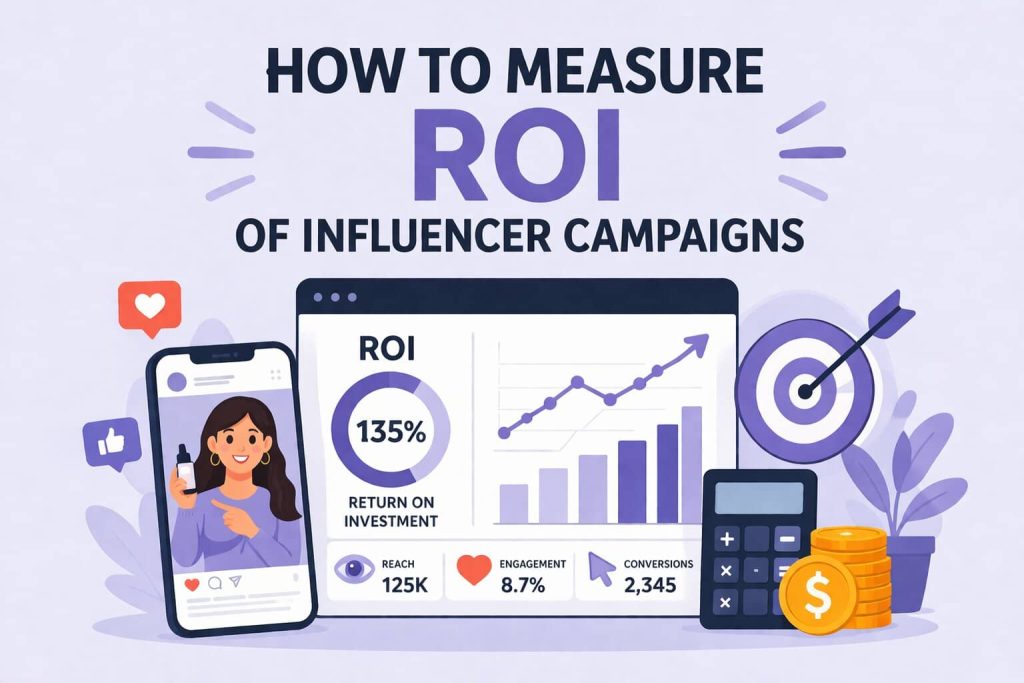
You spent money on an influencer campaign. The post went live, the comments rolled in, and your notifications spiked for a day or two. But when the dust settled, you were left with one uncomfortable question: did it actually work? This is the reality for the vast majority of small and mid-sized businesses running influencer campaigns today. They invest budget, time, and creative energy into collaborations – and then measure success by how many likes the post received.
The problem is not a lack of data. Platforms like Instagram, TikTok, and YouTube generate enormous amounts of performance information after every post. The problem is knowing which data matters, how to connect it to business outcomes, and how to calculate whether your spend generated a meaningful return. Without this framework, influencer marketing remains a leap of faith rather than a repeatable, optimisable growth channel.
Measuring influencer ROI is genuinely harder than measuring the ROI of, say, a Google Ads campaign – where every click and conversion is logged automatically. Influencer content creates awareness, shifts perception, and builds trust in ways that do not always show up as a direct line from post to purchase. But that difficulty is not an excuse to skip measurement altogether. It simply means you need a smarter framework.
This guide gives you exactly that. You will learn how to define goals before a campaign begins, which metrics to track and what they actually mean, how to set up tracking so attribution is as clean as possible, how to calculate ROI using the right formula for your campaign type, and how to build a process that improves with every collaboration. Whether you are running your first influencer campaign or trying to bring rigour to an existing programme, this framework applies.
Step 1 – Define Your Goals Before the Campaign Starts
The single most important thing you can do to ensure a measurable influencer campaign is to define success before the campaign begins – not after. This sounds obvious, but it is the step most commonly skipped. When brands skip goal-setting, they end up measuring whatever data is available rather than the data that actually reflects performance. The result is a post-campaign report full of numbers that tell you very little about whether the investment was worthwhile.
The Three Core Campaign Objectives
Influencer campaigns typically serve one of three primary objectives, each requiring a different measurement approach. Understanding which objective your campaign is built around is the starting point for everything that follows.
- Brand awareness: The goal is to put your brand, product, or message in front of audiences who have never encountered it before. Success is measured by reach and impressions – how many unique people saw the content – and by secondary signals like brand search volume growth and new social followers.
- Engagement and consideration: The goal is to generate interaction, interest, and positive sentiment around your brand. Success is measured by engagement rate, comment quality, saves, shares, and profile visits from the influencer’s content.
- Conversion and sales: The goal is to drive a specific action – a purchase, a sign-up, a download, a booking. Success is measured by click-through rate, promo code redemptions, attributed transactions, and cost per acquisition.
Setting SMART Goals for Influencer Campaigns
Once you have identified your primary objective, make it specific and time-bound. A vague goal like ‘increase brand awareness’ is unmeasurable. A SMART goal – Specific, Measurable, Achievable, Relevant, Time-bound – gives you a clear benchmark to evaluate against. For example, ‘reach 50,000 unique accounts and generate 500 new website visits within seven days of the post going live’ is a goal you can actually measure.
It is also worth mapping your influencer campaign goals to your wider business KPIs. If your business is currently prioritising new customer acquisition, your influencer campaigns should be optimised and measured for CPA (cost per acquisition). If you are launching a new product, brand awareness reach and earned media value may be the right primary metrics. The influencer campaign does not exist in isolation – it should be accountable to the same business outcomes as your other marketing investments.
Goal-to-Metric Mapping
| Objective | Primary KPI | Secondary KPI | Tracking Tool |
|---|---|---|---|
| Brand awareness | Reach / Impressions | Brand search lift | Google Search Console |
| Engagement | Engagement rate | Saves & shares | Platform Insights |
| Conversion | CPA / Revenue | Click-through rate | UTM + Analytics |
| Community growth | New followers | Comment quality | Platform Insights |
Step 2 – Understand the Key Metrics (and What They Actually Mean)
Influencer campaigns generate a lot of data, and not all of it is equally meaningful. One of the most common mistakes brands make is optimising for metrics that feel impressive but do not correlate with actual business value. Before you measure anything, you need to understand what each metric represents, how to calculate it, and what a healthy benchmark looks like.
Reach and Impressions
Reach refers to the number of unique accounts that saw the content. Impressions refers to the total number of times the content was displayed, including multiple views from the same account. For awareness campaigns, reach is the more meaningful figure because it tells you how many distinct people your brand was exposed to. Impressions can be inflated by people watching a video multiple times or seeing a post in different contexts, so use it as a secondary signal rather than the primary measure of audience size.
Engagement Rate
Engagement rate is calculated by dividing the total number of engagements (likes, comments, saves, shares) by the number of followers or reach, then multiplying by 100 to get a percentage. It is the most widely used indicator of how genuinely an audience is responding to content. Benchmarks vary by platform and influencer tier, but as a general guide, a healthy engagement rate on Instagram sits between 2 and 4 percent for micro influencers, while TikTok creators at the same tier often achieve 5 to 8 percent. Anything under 1 percent at the nano or micro level is a signal that the audience is passive or disengaged.
Click-Through Rate and Conversion Rate
Click-through rate (CTR) measures the percentage of people who clicked a link after seeing the influencer’s content. It is particularly relevant for campaigns with a direct response objective. Conversion rate measures the percentage of those clickers who then completed the desired action – a purchase, sign-up, or download. Together, CTR and conversion rate give you a picture of the full funnel from content exposure to business outcome. Low CTR suggests the content or call-to-action is not compelling enough. Low conversion rate after a good CTR suggests a problem with the landing page or the offer itself – not the influencer.
Earned Media Value (EMV)
Earned Media Value is a proxy metric that estimates the monetary worth of organic exposure generated by an influencer’s content. It is calculated by multiplying total impressions by a CPM (cost per thousand impressions) benchmark from paid advertising in your industry. For example, if a post received 80,000 impressions and the CPM for comparable paid social ads in your sector is Rs. 400, the EMV would be Rs. 32,000. EMV is useful for framing the relative value of organic coverage, especially for awareness campaigns where direct revenue attribution is difficult. However, it should be treated as a comparative benchmark rather than a real return figure – it represents what you would have paid for equivalent paid reach, not actual revenue earned.
Metrics to Stop Obsessing Over
Not all available data is worth your attention. Several metrics feel significant but frequently mislead small business owners evaluating campaign performance. The following deserve a much lower share of your analytical focus:
- Raw follower count of the influencer: a large following does not guarantee audience quality, engagement, or purchase intent.
- Total likes on a post: likes are the most passive form of engagement and have declined in significance as platforms have deprioritised them algorithmically.
- Comment count without content analysis: 200 comments of ‘Great!’ and a single emoji each are worth far less than 30 substantive comments asking where to buy the product.
- Story views in isolation: story reach must be compared to the influencer’s total audience size to be meaningful – 5,000 story views from a 6,000-follower account is exceptional; from a 500,000-follower account, it signals low engagement.
Step 3 – Set Up Tracking Before the Campaign Goes Live
Measurement infrastructure must be in place before the campaign launches, not assembled afterwards. The most common tracking failure is brands asking ‘how do we measure this?’ after the post has already gone live – at which point clean attribution is nearly impossible. Setting up tracking is not technically complex, and for most small businesses the tools required are either free or built into platforms they already use.
UTM Parameters
UTM parameters are tags you add to the end of a URL that allow Google Analytics to identify exactly where a visitor came from. By creating a unique UTM-tagged link for each influencer, you can see precisely how much traffic each collaboration is driving to your website, which pages they are visiting, and whether they are converting. A well-structured UTM link for an influencer campaign includes the source (the platform), the medium (influencer), and the campaign name. Tools like Google’s Campaign URL Builder make this process straightforward and free.
For example, a UTM link for a micro influencer named Priya posting on Instagram might look like this: yourwebsite.com/product?utm_source=instagram&utm_medium=influencer&utm_campaign=priya_march2026. When you check Google Analytics after the campaign, you will see exactly how many sessions, pageviews, and conversions came specifically from Priya’s content.
Unique Promo Codes
A unique discount or promo code per influencer is the most reliable tool for attributing direct sales, especially on e-commerce platforms. When a customer uses the code at checkout, the sale is attributed to that creator regardless of whether they clicked a tracked link first. This matters because many customers see influencer content on mobile, then purchase later on desktop – a journey that UTM tracking often misses. Promo codes capture these conversions that would otherwise appear as unattributed direct traffic.
Platform-Native Tracking Tools
Both Instagram and TikTok offer native tools that improve attribution when used correctly. Instagram Collab posts, where both the creator and the brand are listed as co-authors, allow the brand to view shared post analytics directly in their own Insights dashboard. TikTok Spark Ads allow you to boost an influencer’s organic post as a paid ad while retaining the original engagement count – and provide full ad-level reporting including CTR, conversions, and cost metrics.
Capturing Your Pre-Campaign Baseline
Before any campaign launches, record your current baseline metrics so you can measure uplift accurately. The key numbers to capture are your current website traffic (by source), your follower count on relevant platforms, your average weekly organic impressions, and your brand search volume in Google Search Console. Without this baseline, any increases you observe after the campaign could be attributed to seasonal trends, other marketing activity, or algorithm changes rather than the influencer collaboration specifically.
Step 4 – Calculate Your Influencer Campaign ROI
With your goals defined, your metrics understood, and your tracking in place, you now have everything needed to calculate campaign ROI. The calculation itself is straightforward for conversion-focused campaigns, and requires a few additional steps for awareness-focused ones.
The Core ROI Formula
For campaigns with a direct revenue objective, the standard ROI formula applies:
ROI (%) = (Revenue Generated − Total Campaign Cost) ÷ Total Campaign Cost × 100
Total campaign cost must include everything: the influencer fee or product gifting value, any platform subscription costs used for the campaign, content production support, and any paid amplification (e.g., boosting the post as a Spark Ad). Brands often undercount costs by forgetting the time cost of campaign management or the retail value of gifted products – both of which belong in the cost figure for an accurate ROI calculation.
Calculating ROI for Awareness Campaigns
For campaigns where the primary objective is awareness rather than direct sales, EMV provides a useful ROI proxy. Instead of revenue, you use the EMV as your ‘return’ figure and compare it against your campaign cost. If you spent Rs. 20,000 on an influencer collaboration and the resulting impressions have an EMV of Rs. 55,000 based on your industry CPM benchmark, the implied EMV ROI is 175 percent. This figure does not represent actual revenue, but it tells you whether the organic exposure you generated was worth more or less than equivalent paid media coverage.
Cost Per Engagement and Cost Per Acquisition
Two additional efficiency metrics are worth calculating for every campaign, regardless of objective. Cost Per Engagement (CPE) is calculated by dividing total campaign cost by total engagements. It tells you how efficiently your budget is converting into audience interaction, and is the most reliable metric for comparing the relative performance of different influencers. Cost Per Acquisition (CPA) divides total campaign cost by the number of conversions (purchases, sign-ups, etc.) driven by the campaign. CPA is the closest influencer marketing equivalent to a paid ad performance metric and is the most direct measure of conversion efficiency.
Worked Example: A Rs. 30,000 Micro-Influencer Campaign
To make this concrete, here is a realistic step-by-step ROI calculation for a small e-commerce business running a micro-influencer campaign.
- Campaign cost: Rs. 25,000 influencer fee + Rs. 2,000 product gifting + Rs. 3,000 affiliate platform fee = Rs. 30,000 total
- Promo code redemptions: 38 orders attributed to the influencer’s unique code
- Average order value: Rs. 1,400
- Revenue attributed: 38 x Rs. 1,400 = Rs. 53,200
- ROI: (Rs. 53,200 − Rs. 30,000) ÷ Rs. 30,000 x 100 = 77.3%
- CPA: Rs. 30,000 ÷ 38 = Rs. 789 per customer acquired
- CPE: Rs. 30,000 ÷ 4,200 total engagements = Rs. 7.14 per engagement
A 77 percent ROI from a single micro-influencer collaboration is a meaningful return. More importantly, the CPA of Rs. 789 gives the business a benchmark: if this is lower than their average customer acquisition cost across other channels, influencer marketing is proving itself as a competitive acquisition channel worth scaling.
Step 5 – Analyse Results and Build a Repeatable Process
A single campaign measurement tells you what happened once. A systematic post-campaign analysis process tells you why it happened and how to improve. The businesses that consistently get strong returns from influencer marketing are not simply lucky with their creator choices – they have built a disciplined review process that compounds learning across every collaboration.
Building Your Post-Campaign Report
After every campaign, produce a simple one-page report that captures the core metrics against the goals you set before launch. This does not need to be elaborate. A well-structured post-campaign report for a small business should include the campaign objective and SMART goal, actual performance against each KPI, total spend and calculated ROI or EMV ROI, a brief qualitative assessment of content quality and audience sentiment, and a clear recommendation: continue, adjust, or discontinue the partnership.
Over time, this archive of reports becomes one of your most valuable marketing assets. It allows you to identify patterns – which content formats consistently outperform, which niches convert better for your product, which platforms deliver the strongest CPA – that would be invisible from looking at individual campaigns in isolation.
Diagnosing Underperformance
When a campaign does not deliver expected results, the instinct is often to blame the influencer. But underperformance has multiple possible causes, and identifying the right one is essential to making the correct adjustment. Before concluding that a creator was the wrong choice, ask the following:
- Was the brief too restrictive? Over-scripted content often underperforms because it sounds inauthentic to the creator’s audience.
- Was the product-audience fit genuinely strong? Even a well-executed post will underperform if the creator’s followers have no natural interest in your product category.
- Was the timing right? Posts published during low-engagement periods (early morning, late Sunday night) or during competing cultural moments can significantly underperform the same content published at peak times.
- Was the call to action clear? Audience members who were interested but given no clear next step represent lost conversion opportunities that are the brand’s responsibility, not the creator’s.
Creating an Influencer Scorecard
As you run more campaigns, build a simple scorecard that grades each creator across a consistent set of dimensions: CPE, CPA (where applicable), content quality, audience sentiment, ease of working with, and adherence to brief and deadlines. This scorecard transforms your creator roster from a list of names and contact details into a ranked, data-driven asset. When you are planning the next campaign, you can immediately identify which creators have consistently delivered strong results and prioritise deepening those relationships.
Tools and Platforms for Measuring Influencer ROI in 2026
The right measurement tools depend on your campaign volume, budget, and technical capacity. The good news is that effective influencer ROI measurement does not require expensive software – the free tier of available tools is sufficient for most small businesses running two to five campaigns per month.
Free Tools for Small Businesses
Google Analytics 4 combined with UTM-tagged links is the foundation of any influencer measurement setup. It is free, integrates with virtually every website platform, and gives you session-level attribution data for every influencer collaboration. Pair this with Google Search Console to track brand search volume uplift – one of the most reliable indirect signals of awareness campaign effectiveness. Both Instagram and TikTok provide native Insights data to creator accounts, which the creator should share with you as part of your collaboration agreement.
Mid-Tier Platforms
For businesses running more frequent campaigns or needing to vet creators more rigorously, platforms like Modash and HypeAuditor offer audience quality analysis, engagement benchmarking, and basic campaign reporting. These tools are particularly useful at the discovery and vetting stage – they allow you to verify audience authenticity and engagement rate before committing budget to a collaboration. Subscription costs are modest and typically justify themselves after one avoided bad partnership.
Full-Stack Influencer Management Platforms
At the higher end, platforms like Grin, Aspire, and Influencity offer end-to-end campaign management including creator discovery, outreach, brief management, content approval, affiliate link generation, and ROI dashboards. These are designed for businesses running ten or more campaigns per month and are priced accordingly. For most small businesses, the free and mid-tier tools are entirely sufficient – and adding a full-stack platform before you have established a repeatable campaign process is unlikely to accelerate results.
E-Commerce Integrations
If your business runs on Shopify, the Shopify Collabs feature allows you to manage affiliate partnerships, generate unique discount codes, and track attributed revenue directly within your Shopify dashboard at no additional cost. WooCommerce has several affiliate tracking plugins that offer similar functionality. For businesses working with multiple creators simultaneously and needing more robust affiliate management, Impact.com is the industry-standard platform for creator affiliate programmes and integrates with most major e-commerce stacks.
Frequently Asked Questions
Q1: What is a good ROI for an influencer marketing campaign?
Industry benchmarks generally suggest a 5:1 ratio – meaning five rupees or dollars in value returned for every one spent – as a reasonable baseline for influencer campaigns. However, ROI varies significantly depending on your campaign objective, product margin, and how you define ‘return.’ E-commerce brands running conversion-focused campaigns with well-tracked promo codes often achieve ROI ratios of 6:1 to 10:1. Awareness campaigns measured via EMV may appear to generate higher multipliers but represent estimated media value rather than actual revenue. The most meaningful benchmark is not an industry average but your own cost per acquisition compared to other channels – if influencer marketing is delivering customers at a lower CPA than paid search or social ads, it is performing well regardless of what the industry average says.
Q2: How do I track influencer sales without an affiliate platform?
The simplest and most reliable method requires no platform at all. Create a unique promo or discount code for each influencer – for example, NEHA15 for a ten percent discount – and set it up in your Shopify, WooCommerce, or POS system. When a customer uses that code at checkout, the sale is directly attributed to that creator. Complement this with a UTM-tagged link in the influencer’s bio or story swipe-up to capture click-through data in Google Analytics. Together, these two free tools give you clean sales attribution without any additional software investment. The only limitation is that you will not capture orders from customers who saw the post, did not click the link, but searched your brand directly before purchasing – this tends to undercount rather than overcount, so treat your tracked figures as a conservative floor rather than the full picture.
Q3: Can I measure ROI for brand awareness campaigns?
Yes – but it requires a different measurement framework than conversion campaigns. For awareness, the primary metrics are reach (unique accounts who saw the content) and impressions, measured against your CPM benchmark for comparable paid media. Beyond these, track secondary signals that indicate real-world brand impact: brand search volume in Google Search Console (a direct measure of how many more people searched for your brand by name after the campaign), new follower growth on your own social accounts in the week after the post, and direct website traffic uplift compared to your pre-campaign baseline. Earned Media Value provides a monetary framing for awareness returns, though it should be used comparatively rather than as a revenue figure. The goal for awareness campaigns is not to prove an immediate financial return but to demonstrate that your brand reached the right people at a cost that compares favourably to equivalent paid media.
Q4: What is Earned Media Value and how do I calculate it?
Earned Media Value estimates the monetary equivalent of organic content exposure by applying the cost framework of paid advertising. The most straightforward calculation multiplies total impressions generated by a campaign by the CPM rate for comparable paid ads in your industry and on your platform. For example, if an influencer’s post generated 90,000 impressions and the average CPM for Instagram paid placements in your category is Rs. 500, the EMV is Rs. 45,000. If you spent Rs. 18,000 on the collaboration, the implied EMV ROI is 150 percent. EMV is most useful as a comparative tool – it helps you decide whether organic influencer exposure is more or less cost-efficient than paying for the same reach directly. It does not represent actual revenue earned and should never be presented as such in your financial reporting.
Q5: How long should I wait before measuring campaign results?
The measurement timeline should reflect the content type and platform. For a standard Instagram feed post or TikTok video, the majority of engagement happens within the first 48 to 72 hours of publication. Take your first engagement reading at 48 hours and your final reading at seven days for a complete picture. For conversion data, allow a full 30-day window – particularly for higher-value purchases where the customer may see the content, research the product, and return to purchase days or even weeks later. YouTube content and Substack newsletters have significantly longer content lifespans; a YouTube review may continue driving meaningful traffic and conversions for months after publication, so measure at 30, 60, and 90 days for long-form platform content. Always record your final metrics in writing before the campaign data becomes too old to retrieve from platform dashboards.
Final Thoughts
Measuring influencer ROI is not about building a perfect attribution system – it is about making progressively better decisions with every campaign you run. Start with clear goals. Put simple tracking in place before the post goes live. Calculate your results honestly, including all costs. And build a log that compounds your learning over time. The brands that consistently win at influencer marketing are not the ones with the biggest budgets or the most sophisticated tools – they are the ones that treat measurement as a discipline, not an afterthought.