
Think about the last time you made a significant purchase decision. Chances are, it did not happen after a single message. You probably saw an ad, visited a website, received an email, maybe got a text reminder, saw the brand again in your social feed, and then finally converted – days or even weeks after that first touchpoint. This is not a coincidence. It is the customer journey, and it unfolds across multiple channels simultaneously.
Yet most marketing teams still run their drip campaigns through a single channel. They build email sequences, set them live, and hope for the best. The problem is that email alone reaches only a fraction of the audience a brand needs to influence. Some contacts ignore their inbox but respond instantly to a text message. Others scroll past emails but engage with retargeting ads. When you limit your campaign to one channel, you are essentially handing a competitive advantage to every brand willing to meet customers where they actually are.
Multi-channel drip campaigns solve this problem by delivering a coordinated, automated sequence of messages across email, SMS, push notifications, social retargeting ads, and more – all timed and personalised to each contact’s behaviour. Research consistently backs up the impact: marketers using three or more channels in a campaign see 287% higher purchase rates than those using a single channel, according to data from Omnisend. The engagement gap is just as striking – multi-channel campaigns generate nearly four times the engagement of single-channel efforts.
This guide walks you through every stage of setting up a multi-channel drip campaign from scratch. You will learn what these campaigns are and why they work, how to plan one strategically, which tools to use, how to build the sequence step by step, and how to measure and improve performance over time. Whether you are a marketing manager at a growing SaaS company, an e-commerce brand owner, or a digital marketer looking to level up your automation strategy, this guide gives you everything you need to get started.
What Is a Multi-Channel Drip Campaign?
Before getting into tactics, it is worth defining the term precisely, because it gets used loosely in ways that can lead to confusion about what is actually involved.
A drip campaign is a pre-written sequence of messages sent automatically to contacts over time. The sequence is triggered by a specific event – a form submission, a product purchase, a free trial sign-up, or a period of inactivity – and each message drips out at predetermined intervals, guided by the logic you define. The term comes from the idea of water dripping steadily: consistent, measured, and cumulative.
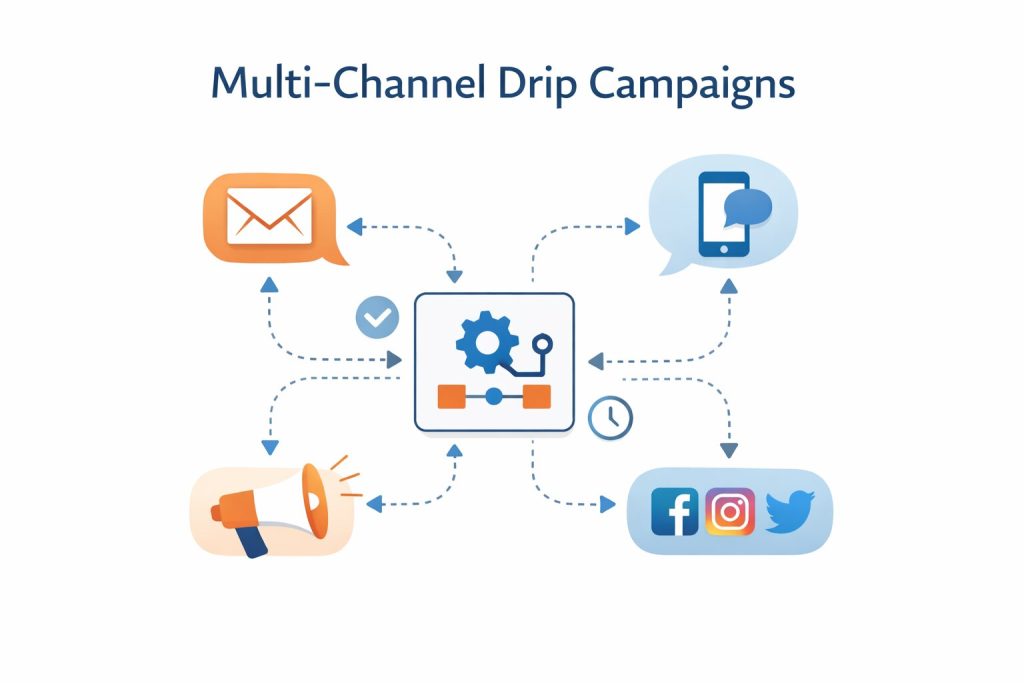
A multi-channel drip campaign takes this same concept and distributes it across more than one communication channel. Rather than sending all messages via email, the sequence might open with a welcome email, follow up with an SMS on day two, serve a retargeting ad on day four if the contact has not converted, and trigger a push notification when they return to the website. Every touchpoint is coordinated, timed, and tracked as part of a single unified campaign – not as disconnected blasts from separate teams.
How It Differs from a Standard Email Drip
The distinction matters because multi-channel campaigns require a fundamentally different mindset and infrastructure. A standard email drip is essentially a publishing schedule – you write a series of emails, set the delays, and the platform sends them one by one regardless of what the contact does in between. Multi-channel campaigns, by contrast, are responsive. They monitor contact behaviour across every channel and adapt the next message based on what the contact did or did not do.
If a contact opens your first email but does not click the call-to-action, the campaign might send an SMS follow-up the next morning. If they click the SMS link but still do not convert, a retargeting ad might appear in their Facebook feed that evening. If they convert at any point, they exit the campaign entirely and enter a different sequence. This kind of behavioural orchestration is only possible with a multi-channel architecture, and it is precisely what makes these campaigns so much more effective than their single-channel equivalents.
Channels Commonly Used in Drip Campaigns
The channels you include in a campaign depend on your audience, your product, and your platform capabilities. The most commonly used channels are:
- Email: The workhorse of most drip campaigns. Best for detailed content, educational nurturing, product onboarding, and re-engagement sequences. Email provides the most space for storytelling and persuasion.
- SMS and MMS: High-impact for time-sensitive messages. SMS boasts average open rates of around 98%, making it ideal for limited-time offers, appointment reminders, cart abandonment follow-ups, and urgent nudges.
- Push notifications: Delivered directly to a contact’s device via browser or mobile app. Excellent for product updates, flash promotions, and re-engagement when a user has not opened the app in several days.
- Social media retargeting ads: Facebook, Instagram, and LinkedIn ads that target custom audiences built from your CRM or pixel data. These keep your brand visible in between direct messages and are particularly effective for warming up leads who have not yet converted.
- In-app messages: For SaaS products and mobile apps, contextual messages delivered inside the product itself at moments of high relevance – when a user is actively engaged but has not yet discovered a key feature.
Why Multi-Channel Drip Campaigns Work
Understanding the mechanics of why multi-channel campaigns outperform single-channel ones helps you make better decisions when designing your own sequences. There are four core reasons.
Higher Reach Across a Fragmented Audience
No single channel reaches every member of your audience with equal effectiveness. Email inboxes are crowded and open rates have been declining for years as brands compete for the same eyeballs. SMS reaches people quickly and reliably, but not everyone opts in. Push notifications are powerful for app users but irrelevant for anyone who has not installed your app. Social ads have broad reach but low click-through rates.
Multi-channel campaigns solve the reach problem by stacking channels. If email does not land, SMS might. If SMS does not land, a retargeting ad might. Each additional channel increases the probability that your message gets through to the right person at the right moment, without requiring you to send more messages on any single channel.
Consistent Brand Storytelling
When every channel you use carries the same narrative – the same offer, the same tone, the same value proposition – the cumulative effect on brand trust is significant. Each touchpoint reinforces the last. A contact who sees your email, then receives an SMS with the same message framed differently, then encounters a social ad showing them a relevant testimonial, is experiencing a coherent story that builds conviction progressively.
The opposite is also true. When channels are managed independently – the email team running one message, the SMS team running another, the ads team running a third – the contact receives contradictory or confusing signals. Multi-channel drip campaigns enforce coordination by design, because all messaging flows from a single campaign logic.
Behavioural Personalisation at Scale
The most powerful aspect of multi-channel automation is the ability to adapt the sequence in real time based on what each contact actually does. This is personalisation at scale – every contact gets a different experience based on their individual behaviour, but no one is sitting at a desk manually adjusting sequences for each person.
A contact who opens every email but never clicks gets a different follow-up path than one who ignores email entirely but opens every SMS. A contact who visits the pricing page three times without converting might be moved into a high-priority sequence that adds a personal sales call to the automation. This kind of responsive, behaviour-driven sequencing consistently outperforms fixed, time-based drips because it is rooted in actual intent signals rather than assumptions.
Compounding Engagement Over Time
Individual marketing channels deliver diminishing returns over time as audiences become habituated to the format. Email fatigue is real. SMS fatigue is real. But by rotating channels and varying the format and tone of messages, multi-channel campaigns maintain attention across a longer sequence without triggering the avoidance response that single-channel campaigns often produce after the third or fourth message.
Planning Your Multi-Channel Drip Campaign
The quality of your planning determines the quality of your campaign. Teams that skip the planning stage and jump straight into building sequences in their automation platform almost always end up with incoherent messaging, poorly timed touchpoints, and unclear success metrics. Investing an hour or two in structured planning before touching your platform saves significantly more time during execution.
Step 1: Define a Specific, Measurable Campaign Goal
Vague goals produce vague results. Before you choose channels, write copy, or configure any automation logic, articulate exactly what you want this campaign to achieve. The goal should be specific enough that you can look at a number at the end of the campaign and know definitively whether you succeeded.
Effective campaign goals are outcome-focused and time-bound. Examples include: convert 20% of free trial users to paid subscribers within 14 days of sign-up; recover 25% of abandoned cart customers within 48 hours; onboard new customers to three core product features within the first week; or re-engage 15% of inactive subscribers who have not opened an email in 90 days.
The goal you choose directly shapes every subsequent decision – the trigger event, the sequence length, the channel mix, the message content, and the primary metric you will use to measure success.
Step 2: Identify and Segment Your Audience
Not every contact in your database should receive the same campaign. Sending an onboarding sequence to existing customers, or a re-engagement campaign to brand new leads, wastes messages and erodes trust. Precise audience segmentation is the foundation of relevance, and relevance is the foundation of conversion.
Segment your audience before building any sequence. The key segmentation dimensions to consider are lifecycle stage (new lead, active trial user, paying customer, churned customer), behavioural signals (pages visited, emails opened, features used, products viewed), acquisition source (organic search, paid ad, referral, event attendance), and demographic or firmographic characteristics (industry, company size, role, geographic region).
The tighter your segment, the more specifically you can tailor the messaging – and the higher your conversion rate will be. A campaign targeted at trial users who activated the account but never completed the onboarding checklist will outperform a generic onboarding campaign sent to all new sign-ups, because the former addresses a specific situation rather than a broad one.
Step 3: Map the Customer Journey
Before writing a single message, sketch the path your contact takes from the trigger event to the desired outcome. For each stage of that journey, identify three things: what the contact currently knows and believes, what they need to believe in order to move forward, and what friction or objection might be preventing that belief shift.
This journey map becomes the blueprint for your sequence. Each message in the campaign should move the contact one step forward along this path – resolving a specific objection, providing a specific piece of evidence, or delivering a specific piece of value that makes the next step feel natural. Without this map, sequences tend to repeat the same message in different words rather than building a progressive case for conversion.
Step 4: Choose Your Channel Mix
With a clear goal, a defined audience, and a mapped journey, you are ready to decide which channels to use. Resist the temptation to include every available channel. A campaign running across two well-coordinated channels consistently outperforms one running across five poorly integrated ones.
Select channels based on where your specific audience is most active (past campaign performance and platform analytics are your best guides here), the nature of each message (detailed nurturing content suits email; urgent short-form messages suit SMS; brand reinforcement suits retargeting ads), your platform’s orchestration capabilities, and your compliance posture – SMS and push notifications require explicit opt-in consent, which means you need to verify that your audience has granted permission before including those channels.
Choosing the Right Tools
The platform you use to build your campaign is not a minor detail – it determines what is technically possible. A tool that cannot orchestrate multiple channels from a single workflow editor will force you to manage each channel in isolation, which defeats the purpose of a coordinated multi-channel campaign. When evaluating platforms, the most important criterion is whether the tool can manage all your required channels in a single automation canvas, passing contact data and behavioural signals between channels in real time.
All-in-One Automation Platforms
For most marketing teams, an all-in-one platform is the right starting point because it eliminates the data synchronisation problem entirely. When email, SMS, and CRM all live inside the same system, the automation logic can respond to signals from any channel without delays or API calls.
- ActiveCampaign: Covers email, SMS, site messaging, and CRM automation within a single visual workflow builder. Particularly strong for B2B and SaaS teams that need sophisticated behavioural branching and lead scoring.
- Klaviyo: Email and SMS optimised specifically for e-commerce. Deep native integrations with Shopify and WooCommerce make it the leading choice for product-based businesses running cart abandonment, post-purchase, and win-back sequences.
- HubSpot Marketing Hub: Email automation, ad retargeting audiences, and CRM workflow automation within a unified platform. Best suited to teams that want everything in one place and are willing to pay a premium for the integration depth.
- Braze: Enterprise-grade multi-channel orchestration covering email, push, in-app, SMS, and web messaging. Designed for high-volume consumer applications where real-time personalisation at scale is a priority.
When You Need Middleware
Teams using best-in-class point solutions rather than an all-in-one platform often turn to integration middleware to connect their stack. Zapier and Make are the leading no-code options, allowing you to pass data between your email platform, SMS provider, CRM, and ad platforms in real time. This approach gives you more flexibility in tool selection but requires more maintenance and is more prone to synchronisation failures than a native all-in-one solution.
What to Look for in Any Platform
- Native orchestration of all required channels within a single workflow or canvas editor
- Behavioural trigger support – the ability to fire actions based on email opens, link clicks, website visits, purchases, and custom events
- Contact-level frequency capping across all channels simultaneously
- A/B and multivariate testing capabilities across channels, messages, and timing
- Attribution reporting that shows performance per channel, per step, and per campaign
How to Build Your Multi-Channel Drip Campaign
With your strategy defined and your platform selected, you are ready to build. The following six steps walk through the process in the order that minimises rework and catches logic errors before they affect live contacts.
Step 1: Configure the Enrollment Trigger
Every campaign begins with a trigger event that enrolls a contact into the sequence. The trigger is the most consequential decision in the entire campaign setup because it determines the audience’s state of mind at the moment of entry. A contact who just abandoned a shopping cart is in a completely different mindset than one who signed up for a newsletter three weeks ago, and the sequence should reflect that difference.
Common enrollment triggers include form submissions or content downloads, free trial or account sign-ups, shopping cart abandonment or checkout initiation, post-purchase events (which trigger onboarding sequences), and inactivity thresholds (which trigger re-engagement sequences). Configure your trigger precisely, including whether contacts can re-enter the campaign if they trigger the event a second time, and whether there is a waiting period before the first message fires.
Step 2: Design the Sequence Architecture
Before writing a single word of copy, map out the full sequence in a planning document or spreadsheet. For each step in the campaign, define the step number and timing (day 0, day 1, day 3), the channel delivering that message, the goal of that specific message (what should the contact believe or do after receiving it), the success condition (what action confirms the message worked), and the exit condition (what happens to the contact if they convert mid-sequence).
This upfront architecture work is not optional – it is the difference between a campaign that flows logically from one step to the next and a campaign that feels like a series of disconnected messages. It also makes the branching logic in the next step far easier to configure because you will have already thought through every possible path a contact might take.
Step 3: Write Channel-Appropriate Copy for Every Step
One of the most common mistakes in multi-channel campaigns is writing a single message and distributing it identically across all channels. This approach ignores the fundamental differences in format, context, and audience expectation that define each channel. The same core message must be expressed differently depending on where it lands.
Email gives you the most space to tell a story, provide context, and build a case. Subject lines should be 40 to 60 characters, preview text should extend the hook, and the body should focus on a single call-to-action with no more than 300 to 400 words for a typical nurture email. SMS, by contrast, must accomplish its purpose in 160 characters or fewer. Every word counts. The message should convey immediate value or urgency, include a shortened link, and always provide an opt-out instruction to comply with messaging regulations.
Push notifications are even more constrained – 30 characters for the title, 60 to 90 characters for the body – and should feel like a useful alert rather than a marketing message. Retargeting ads operate differently still: the contact may not have seen your previous email or SMS, so the ad copy should be self-contained and reinforce the campaign narrative without assuming prior context.
Across all channels, the tone, voice, and core offer should remain consistent. The contact should experience a coherent conversation as they move through the sequence, not a series of unrelated messages that happen to come from the same brand.
Step 4: Build Behavioural Branching Logic
Behavioural branching is what separates a multi-channel campaign from a simple broadcast sequence. It is the mechanism that makes the campaign responsive – adapting the next step based on what each contact actually did rather than what you assumed they would do.
Set up conditional paths for the most important engagement signals in your sequence. A contact who opens the first email but does not click the CTA might receive an SMS follow-up the next morning that approaches the value proposition from a different angle. A contact who clicks the SMS link but does not complete the desired action might be added to a retargeting ad audience that evening. A contact who shows no engagement across any channel after five days might move into a re-engagement branch that tries a different message format and a reduced-friction offer.
The most important branch of all is the conversion exit. The moment a contact completes the campaign goal – makes a purchase, activates a feature, books a call – they should immediately exit the current campaign and move into the appropriate next sequence. Continuing to send conversion-focused messages to someone who has already converted is one of the fastest ways to lose the trust you just earned.
Step 5: Set Up Frequency Caps and Suppression Rules
One of the most common reasons multi-channel campaigns fail is over-messaging. When email, SMS, and push notifications all fire according to their individual schedules without any cross-channel coordination, a contact can receive four or five messages in a single day from the same brand. This does not feel like a helpful campaign – it feels like harassment, and it drives unsubscribes across every channel simultaneously.
Configure global frequency caps at the contact level that apply across all channels combined, not just per channel. A reasonable starting point for most campaigns is no more than two messages per day in total across all channels during peak sequence density, and no more than one message per day during lower-intensity phases. Build suppression lists for contacts who have recently purchased, submitted a support ticket, or unsubscribed from any channel. For SMS specifically, configure quiet hours that prevent messages from firing between 9 PM and 8 AM in the contact’s local time zone.
Step 6: Test Thoroughly Before Launch
A systematic pre-launch QA process is non-negotiable for multi-channel campaigns because errors compound across channels. A broken link in an email is one problem. A broken link in the email plus a misfiring SMS trigger plus a retargeting audience that did not sync correctly is a campaign-level failure that may have already reached thousands of contacts before anyone notices.
Walk through the following checks before activating any campaign:
- Send test messages to yourself on every channel in the sequence and verify that formatting, personalisation tokens, links, and media all render correctly on mobile devices
- Walk through every branch path manually using test contacts to confirm that the conditional logic fires as intended
- Test all exit conditions – trigger the conversion event and confirm that the contact is correctly removed from the active sequence
- Verify that opt-out mechanics work on every channel: one-click unsubscribe for email, STOP reply for SMS, and dismiss for push notifications
- Check that frequency caps prevent multiple messages from firing on the same day by adjusting test contact timing
- Review every message on a mobile device – the majority of email and SMS is read on mobile, and desktop-previewed copy often breaks on smaller screens
Measuring and Optimising Performance
Launching a campaign is not the end of the work – it is the beginning of the optimisation cycle. Multi-channel campaigns generate rich performance data at every step and across every channel, and using that data to continuously improve the sequence is what separates campaigns that plateau from campaigns that compound over time.
Key Metrics to Track
Measure performance at two levels simultaneously: the campaign level, which tells you whether the overall goal is being achieved, and the step level, which tells you which specific messages and channels are working and which are creating drop-off.
At the campaign level, your primary metric is whatever outcome you defined in the planning stage – conversion rate, trial-to-paid rate, revenue attributed, or re-engagement rate. Track this weekly and compare it against the baseline you established before the campaign launched.
At the step level, track channel-specific engagement metrics:
- Email: Open rate, click-through rate, unsubscribe rate, and conversion rate per message
- SMS: Delivery rate, click rate, opt-out rate, and conversion rate per message
- Push notifications: Delivery rate, open rate, dismiss rate, and downstream conversion rate
- Retargeting ads: Impression frequency, click-through rate, cost per click, and return on ad spend
A/B Testing Priorities
Testing everything simultaneously leads to inconclusive results because you cannot isolate what drove any given change in performance. Start with the variables most likely to have the largest impact and test them sequentially.
Email subject lines consistently deliver the highest testing ROI because even a modest improvement in open rate – say, moving from 22% to 28% – compounds across every campaign. Test subject line length, personalisation, question-based versus statement-based formats, and urgency language. After subject lines, test send timing (morning versus afternoon, and weekday versus weekend for your specific audience), CTA copy and button text (specific action-oriented language typically outperforms generic phrases), and channel sequence order (does email-first or SMS-first produce better downstream conversion for your specific audience?).
Ongoing Optimisation Cadence
Review campaign performance weekly for the first four weeks after launch, when you are collecting the baseline data needed to make meaningful comparisons. After the first month, move to a biweekly review cycle unless performance metrics shift significantly. Retire or rewrite any individual step where email click-through rate falls below 1% or SMS click rate falls below 4%, as these are reliable signals that the message is not resonating with the audience at that stage of the sequence. Small, consistent improvements to individual steps compound into significant overall campaign performance gains over time.
Frequently Asked Questions
What is the difference between a drip campaign and an email newsletter?
A newsletter is a broadcast – it goes to your entire subscriber list at a scheduled time, regardless of what any individual subscriber has done or where they are in the customer journey. A drip campaign, by contrast, is triggered by a specific action and delivers a personalised sequence tied to that individual contact’s stage and behaviour. Newsletters are primarily about sharing information and maintaining brand presence. Drip campaigns are engineered to drive a specific outcome: a conversion, an activation, a renewal. The two serve different purposes and should be managed as separate strategies within your overall marketing programme.
How many channels should I include in a drip campaign?
Start with two channels before expanding to three or more. Email plus SMS covers the majority of use cases effectively and is manageable from a content production and compliance standpoint. Adding a third channel – typically retargeting ads for awareness reinforcement or push notifications for app-based products – makes sense once your two-channel baseline is performing reliably and you have the bandwidth to produce quality content for the additional channel. More channels means more content, more compliance requirements, and more complex branching logic. Two well-coordinated channels will consistently outperform five poorly integrated ones, so resist the temptation to add channels before you are ready to manage them properly.
How long should a multi-channel drip campaign run?
Campaign length is determined entirely by the goal and the natural length of the decision-making process for your specific audience and offer. An abandoned cart recovery sequence might run for 48 to 72 hours across three or four messages, because purchase intent is high and urgency is a legitimate lever. A B2B nurture sequence for a complex enterprise sale might run 60 to 90 days across 10 to 15 touchpoints, because the buying committee needs time to evaluate options and build internal consensus. A SaaS onboarding campaign might run 14 to 21 days, structured around the key activation milestones in the product. The sequence ends when the contact converts, when they exit voluntarily, or when continued messaging is no longer producing meaningful engagement – whichever comes first.
Do I need a large budget to run multi-channel drip campaigns?
No. Email and push notifications are extremely low-cost channels – most platforms include them in base subscription pricing. SMS adds modest per-message costs, typically between $0.01 and $0.05 per message depending on your platform and region, which means a sequence of three SMS messages to 1,000 contacts costs $30 to $150 in message fees. Retargeting ads require a media budget, but campaigns targeting small custom audiences can be run effectively for as little as $5 to $10 per day. The platform itself – an all-in-one tool like ActiveCampaign or Klaviyo – starts at under $20 per month for small lists. The total cost of running a well-built multi-channel campaign for a small business is often under $200 per month, a figure that delivers strong return on investment for virtually any business with a functioning conversion funnel.
How do I avoid overwhelming subscribers with too many messages?
The answer lies in cross-channel frequency management rather than per-channel management. Most marketers set separate frequency limits for email, SMS, and push without considering the cumulative experience for the contact. If your email platform allows one message per day, your SMS platform allows two messages per day, and your push notification platform sends two alerts per day, a contact could theoretically receive five messages from your brand before noon. That is not a campaign – it is noise.
Set a global frequency cap at the contact level that applies across all channels simultaneously. Two messages per day across all channels combined is a reasonable upper limit for most campaigns. Build suppression logic that pauses other channels when a high-frequency channel has recently fired. Respect channel-specific quiet hours, especially for SMS. And most importantly, let behavioural data guide your sequencing – if a contact is not engaging after three or four messages, the answer is not to send more messages. It is to try a different channel, a different message, or a longer delay.
What is the best trigger event for a multi-channel drip campaign?
The best trigger is the one most precisely matched to your campaign goal. For conversion-focused campaigns, the strongest triggers are those that signal high purchase intent – cart abandonment, pricing page visits, trial sign-up, and free plan usage are all excellent because they indicate a contact who is actively considering making a decision. For onboarding campaigns, the trigger is typically account creation or first login, because that is the moment when a new customer’s attention and motivation are highest. For re-engagement campaigns, the trigger is an inactivity threshold – typically 60 to 90 days of no email opens, no site visits, and no purchases – because at that point, continued passive presence on your list costs money without delivering value.
The key principle is specificity. A trigger that fires when a contact visits the pricing page three times in seven days is far more powerful than a trigger that fires when anyone signs up for the newsletter, because the former captures a specific, high-intent behaviour that tells you exactly where the contact is in their decision process.
How do I know if my multi-channel drip campaign is actually working?
Define your primary success metric before launch and measure it consistently from the day the campaign goes live. This is not just good practice – it is the only way to distinguish genuine performance from random variation. If you define success as a 20% trial-to-paid conversion rate and your campaign achieves 23%, you know it is working. If it achieves 12%, you know it needs significant revision.
Beyond the headline metric, use step-level engagement data to diagnose exactly where the sequence is losing momentum. A well-performing campaign typically shows a gradual and predictable decline in engagement as the sequence progresses – high open rates in the first two messages, tapering off by message five or six as the less-engaged portion of the audience filters itself out. A sharp drop after message one or two, however, signals a problem with either the trigger audience (contacts are entering the campaign too early in their journey) or the first message itself (the opening message is not delivering sufficient value or relevance to earn continued attention). Use this diagnostic data to iterate systematically rather than rebuilding the entire campaign whenever performance falls short of expectations.
Conclusion
Multi-channel drip campaigns represent one of the highest-leverage investments a marketing team can make in their automation infrastructure. They are more complex than single-channel sequences, and that complexity is exactly what makes them worth building – because most of your competitors are still sending single-channel email blasts and hoping for the best.
The core principle to carry forward from this guide is that multi-channel campaigns are not about volume or omnipresence. They are about coordination. Delivering the right message, on the right channel, at the right moment in the customer journey – based on what each individual contact has actually done, not what you assumed they would do – is what drives the outsized results that multi-channel automation consistently delivers.
The path forward is straightforward. Pick one specific campaign goal. Define a tight audience segment. Map the customer journey. Choose two channels. Build the sequence architecture before writing a single word. Write channel-appropriate copy. Configure behavioural branching logic. Set frequency caps. Test before launch. Measure relentlessly and optimise continuously.
That process, applied with discipline and patience, compounds over time into a marketing engine that runs around the clock, responds to individual contact behaviour at scale, and consistently moves people from first touchpoint to conversion without requiring manual intervention.