
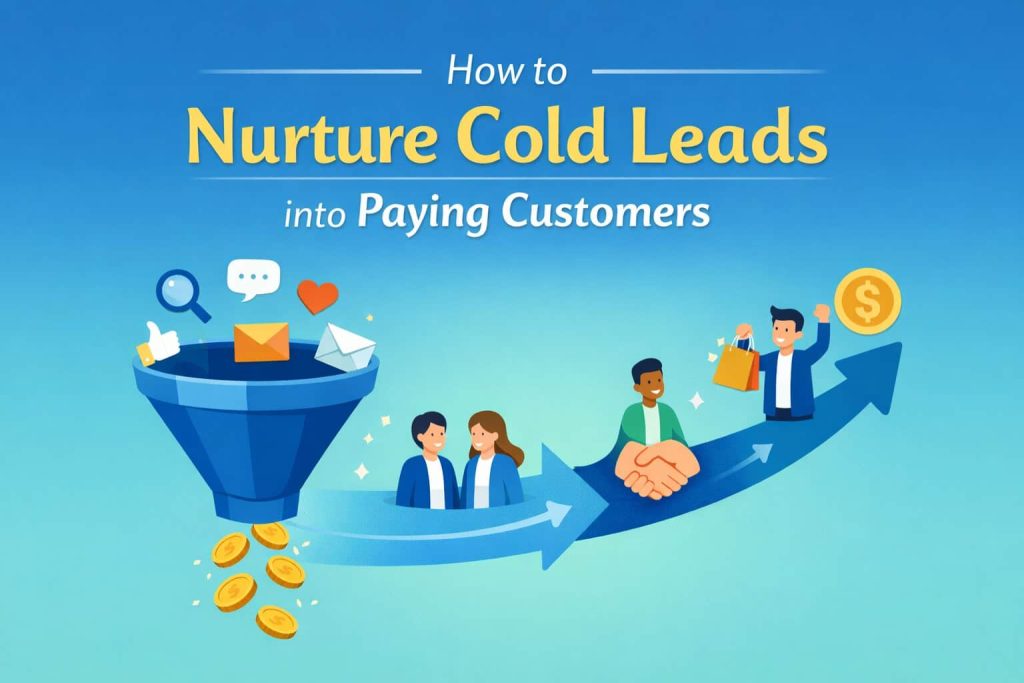
You have a list of leads who showed up once – maybe they downloaded a free guide, registered for a webinar, clicked on an ad, or filled out a contact form – and then went completely silent. No replies. No clicks. No signs of life. If you are like most marketers, you have probably written them off and moved on to chasing the next batch of fresh prospects. That is an expensive mistake.
Cold does not mean dead. In most cases, a lead who has gone quiet is not a lost cause – they are simply a person whose timing has not aligned with your offer yet. Life gets in the way. Budgets get frozen. Priorities shift. But the fact that they engaged with your brand even once means something. They are not strangers. They are warm memories waiting for the right reminder.
This guide is about transforming those quiet, disengaged contacts into paying customers through a process called lead nurturing. You will learn exactly how to understand why leads go cold, how to segment and score them intelligently, how to build an email sequence that re-engages without irritating, how to use content to move people through the buyer journey, and how to know precisely when to hand a lead to your sales team. Every step in this guide is practical, actionable, and built on strategies that work in the real world.
What Is a Cold Lead – and Why Most Businesses Give Up Too Soon
Understanding Lead Temperature
Before you can nurture a cold lead effectively, you need to understand what makes a lead cold in the first place. In marketing, leads are often described by their temperature – a metaphor that captures how close they are to making a buying decision.
A cold lead is someone who has had minimal or one-time contact with your brand and has not shown recent buying intent. They may have downloaded a piece of content six months ago, attended a free webinar but never responded to follow-up, or interacted with one of your social media ads without taking a further step. They are aware that you exist, but they are not actively thinking about your product or service.
A warm lead, by contrast, is actively engaging – opening emails, visiting your website multiple times, reading case studies, or asking questions. And a hot lead is in full decision mode: comparing vendors, visiting pricing pages, requesting demos, and getting ready to commit. The goal of cold lead nurturing is to move people from the first category through the second and into the third.
The Hidden Cost of Abandoning Cold Leads
Here is a sobering reality: research consistently shows that the majority of leads are never followed up on after the first contact. Most businesses make one or two attempts, receive no response, and move on. But studies by organisations like the National Sales Executive Association have found that the vast majority of sales happen after the fifth touchpoint or later. Most salespeople never get there.
The financial implication is significant. Cold leads are not cheap to acquire – whether through paid advertising, content marketing, events, or outbound prospecting, every lead on your list cost time and money to generate. Abandoning them after minimal follow-up is like pouring water into a bucket with a hole in it. The opportunity was there; the follow-through was not.
Beyond the economics, there is another reason not to give up on cold leads: they already know your brand. Unlike a completely cold prospect who has never heard of you, a cold lead has had at least one positive exposure. That prior interaction – however brief – makes them infinitely easier to re-engage than someone starting from zero. The hardest part of marketing is earning attention. With cold leads, you have already done that once.
Step 1: Understand Why the Lead Went Cold
Nurturing cold leads without understanding why they went cold is like prescribing medicine without a diagnosis. The treatment might work by accident, but it is far more likely to miss the mark. Before you craft a single email or design a retargeting ad, you need to investigate the root cause of the disengagement.
The Most Common Reasons Leads Go Cold
Timing is the single biggest reason leads go cold, and it is also the most recoverable. A prospect might have been genuinely interested in your solution but had no budget at the moment, was waiting for internal approval, or was dealing with a competing internal priority that took over their calendar. This type of cold lead is not disinterested – they are delayed. A well-timed re-engagement at the right moment can bring them straight back into an active buying conversation.
Irrelevant communication is another major culprit. When a lead receives follow-up messages that do not match their actual situation – generic emails that could have been sent to anyone, content that addresses problems they do not have, or pitches for products that are clearly a mismatch – they disengage. The subtext they receive is that you do not know them, which makes them feel like a number rather than a person.
Other common causes include:
- Over-communication – too many emails or calls in a short period caused irritation, leading the prospect to tune out or unsubscribe.
- Too much friction – the path from interest to the next logical step was complicated, unclear, or demanded too much commitment too quickly.
- Competitive loss – they chose a competitor, but remain open to switching if their experience disappoints.
- Internal change – a decision-maker left, the company reorganised, or the project was shelved entirely.
How to Diagnose Your Cold Leads Before Reaching Out
The best way to understand a cold lead is to audit the data you already have. Pull up their record in your CRM and look at their full history: Which pages did they visit? What content did they download? How many emails did they open – and which ones? At what point did the engagement stop? The pattern often tells a clear story.
For larger cold lead databases, segment the list by last activity date to identify clusters. Leads who went cold in the last 90 days need a very different approach from leads who have been silent for 18 months. The former group may just need a gentle nudge; the latter may require a more dramatic re-introduction. Treating both groups identically will produce mediocre results for both.
Step 2: Segment and Score Your Cold Leads
Not all cold leads are created equal, and sending the same message to every person on a cold list is a near-guaranteed path to low engagement and high unsubscribe rates. The moment you start treating your cold leads as individuals with different histories, motivations, and needs, your nurturing results will improve dramatically.
Segmentation Strategies That Drive Results
The most effective way to segment cold leads is to combine two dimensions: how long they have been cold, and what they interacted with before they went quiet. These two data points together tell you a great deal about who you are dealing with and what they need to hear next.
A lead who visited your pricing page two months ago and then went cold is a very different prospect from someone who only ever read one blog post a year ago. The pricing-page visitor was in decision mode – something interrupted them. They need a message that removes whatever obstacle stopped them. The blog reader was in awareness mode – they need content that deepens their understanding and moves them toward consideration.
Additional segmentation dimensions worth using include:
- Industry and company size – a startup founder and an enterprise procurement manager have completely different concerns, timelines, and vocabulary.
- Lead source – leads from organic search often have different intent levels than leads from paid social ads or event sign-ups.
- Persona or job role – the person who signed up for your newsletter and the person who requested a demo are on very different journeys, even if both went cold.
Lead Scoring: Prioritising Your Effort
Lead scoring is a system that assigns numerical values to a lead’s actions so you can quickly identify which cold leads are most worth pursuing. The logic is straightforward: not every lead on a cold list deserves the same attention. Some have signals that suggest they were closer to buying. Others show almost no intent. Lead scoring helps you prioritise intelligently rather than treating everyone equally.
High-intent actions – visiting a pricing page, watching a product demo video, downloading a buyer’s guide, or opening multiple emails in a short window – receive higher scores. Low-intent actions – a single blog visit, following your company on LinkedIn, or clicking one link in a newsletter months ago – receive lower scores. Once you have scored your cold list, you can focus your most personalised outreach on the highest-scoring leads while using automated sequences for the rest.
Step 3: Build a Cold Lead Email Nurture Sequence
Email remains the most scalable, measurable, and cost-effective channel for nurturing cold leads. Done well, an email nurture sequence is not spam – it is a structured series of relevant, valuable messages that keep your brand present in a prospect’s life until the timing aligns with their needs. Done poorly, it is exactly the kind of noise that pushes people toward the unsubscribe button.
The difference between the two comes down to three things: relevance, patience, and restraint. Your sequence must feel like it was written for the person receiving it, not blasted to a database. It must be willing to play a long game, delivering value before asking for anything in return. And it must know when to stop pressing, giving the lead space to come back on their own terms.
The Six-Email Cold Lead Re-Engagement Sequence
A six-email sequence gives you enough touchpoints to build genuine momentum without overwhelming a disengaged prospect. Here is how each email should be structured and what it should accomplish:
- Email 1 – The Re-Introduction: Keep it short, warm, and completely devoid of sales pressure. Acknowledge the gap in communication without making it awkward. Lead with something genuinely useful – a new piece of content, a fresh insight, or an industry development they might have missed. The goal is simply to be helpful and re-establish that your brand is worth paying attention to.
- Email 2 – The Value Drop: Share one high-value piece of content that speaks directly to a pain point common in your audience. A short video, a detailed guide, a compelling case study, or a well-researched industry report all work well here. The content should feel like a gift, not a gateway to a sales conversation.
- Email 3 – The Social Proof: Introduce a real customer success story. The more specific the better – name the company, describe the problem they faced, explain what changed after they used your product or service, and include real numbers wherever possible. Specificity is what turns a testimonial from forgettable into persuasive.
- Email 4 – The Soft CTA: Invite the lead to take a low-commitment next step. This might be registering for a free webinar, downloading an advanced guide, taking a free assessment, or watching a short product video. The key is that the ask should feel easy and proportionate – you are not asking them to buy; you are asking them to take one small step further.
- Email 5 – The Problem-Solution: Now you can begin speaking more directly about what you offer. Frame it around a specific problem your lead is likely experiencing – one you have inferred from their industry, role, or past behaviour – and explain how your product or service addresses it concisely and without exaggeration. This is persuasion through relevance, not pressure.
- Email 6 – The Direct Invitation: Be honest and straightforward. Tell the lead that you believe your solution could genuinely help them, give them a clear and easy way to take the next step – a booking link, a reply-to-email, a free trial sign-up – and let them know you are available if they have questions. No urgency tactics, no artificial scarcity. Just a clean, confident invitation.
Best Practices for Cold Lead Email Sequences
Subject lines in cold lead sequences should trigger curiosity rather than announce a product. A subject line like “One thing most teams miss about project management” will outperform “Try our project management tool free today” almost every time. The first invites the reader in; the second signals that a sales message is waiting inside.
Personalisation should go well beyond inserting a first name. The most effective cold lead emails reference what the person actually did – the content they downloaded, the page they visited, the event they attended. This kind of contextual personalisation signals that you paid attention, and it makes the email feel like a message between two professionals rather than an automated blast.
Frequency matters enormously in cold lead sequences. For most B2B audiences, one to two emails per week during the active nurturing phase is the right balance – enough to maintain momentum without triggering fatigue. Once a lead has not responded to the full six-email sequence, shift them to a monthly low-frequency nurture that keeps your brand visible without pressure.
Step 4: Use Content to Warm Leads at Every Stage
Email is the delivery vehicle, but content is the engine of your nurturing strategy. The type of content you share must evolve as your lead moves from cold to warm to hot. Sending the same style of content at every stage – or worse, sending promotional product content to someone who barely knows your brand – signals that you are not paying attention. And inattention is one of the fastest ways to lose a prospect’s trust.
Matching Content to Lead Temperature
For cold leads, the content you share should be entirely educational and carry no sales agenda. This means blog posts that answer real questions, industry reports that provide useful data, how-to videos that teach something practical, and infographics that make complex topics digestible. The measure of success at this stage is not whether someone clicked to learn about your product – it is whether they found what you sent genuinely useful and formed a positive impression of your brand as a result.
As leads begin to warm up – opening emails consistently, clicking links, revisiting your website – the content can become more solution-aware. This is where more detailed content earns its place: comparison guides that position your approach against alternatives, case studies that include your product as the solution to a recognisable problem, and webinars that let prospects see your team’s expertise in action. The goal is to move the conversation from “here is helpful information” to “here is how people like you solve this problem.”
For leads who are nearly warm – showing strong behavioural signals like multiple site visits, pricing page views, or positive email engagement – content should become explicitly decision-enabling. Free trials, live demos, ROI calculators, and detailed product comparisons all serve this stage well. At this point, the prospect is looking for the final piece of evidence that will justify their decision, and your content must provide it.
The Role of Retargeting Ads in Content Nurturing
One of the most common mistakes in cold lead nurturing is relying on email alone. The reality is that even highly engaged email subscribers only open a fraction of the messages they receive. For every lead who reads your nurture email, several more miss it entirely. Retargeting ads solve this problem by ensuring your content reaches leads wherever they browse online, not just when they check their inbox.
By building custom audiences from your email segments in platforms like Facebook, LinkedIn, and Google, you can run retargeting campaigns that mirror the messages in your email sequence. When a lead receives an email about a case study and then sees a related ad featuring a customer testimonial while scrolling LinkedIn the same afternoon, the cumulative effect is far more powerful than either touchpoint alone. The experience feels coordinated and intentional – because it is.
Step 5: Go Multi-Channel for Maximum Reach
Cold leads do not live in your email inbox alone. They scroll LinkedIn during their morning commute, watch YouTube in the evenings, read industry newsletters over coffee, and browse competitor websites before making decisions. A multi-channel nurturing strategy meets them wherever they are, creating the impression of consistent brand presence without requiring an enormous budget or a massive team.
Building a Multi-Channel Nurture Stack
The backbone of any cold lead nurturing strategy is email. It is the most direct, most personal, and most measurable channel available, and it should anchor everything else you do. But email alone has a ceiling. Inbox competition is fierce, open rates are imperfect indicators of engagement, and some of your best potential leads simply are not email-first communicators.
LinkedIn is the natural complement for B2B audiences. A thoughtfully written connection request, followed by a value-first message that references something genuine about the prospect, can re-ignite a cold relationship in a way that no automated email can replicate. Even without direct outreach, a consistent LinkedIn content presence – posts, articles, and engagement with your prospects’ content – keeps your brand visible as a passive touchpoint.
Retargeting ads provide the passive layer of multi-channel nurturing. They require no action from the lead – once set up, they simply follow your cold leads across the web with relevant messages as they browse. Direct mail, while counterintuitive in a digital world, remains remarkably effective for high-value cold leads: a thoughtful physical card or a handwritten note cuts through digital noise in a way that almost nothing else can.
The key to multi-channel nurturing is coordination, not volume. The goal is not to hit a lead from every possible direction simultaneously – that feels like pressure, not care. The goal is to ensure that across all the places a prospect might encounter your brand, the experience feels consistent, relevant, and respectful of their time.
Step 6: Use Timing and Behavioural Triggers to Strike at the Right Moment
All the best-crafted content and carefully designed sequences in the world will underperform if your messages arrive at the wrong moment. Timing is one of the most underestimated variables in cold lead nurturing, and it is also one of the most controllable – thanks to the power of behavioural triggers.
What Are Behavioural Triggers and Why Do They Matter?
A behavioural trigger is an automated action that fires when a lead takes a specific, measurable step. When a cold lead who has not engaged with your emails in three months suddenly visits your pricing page, that is a signal – and it deserves an immediate, relevant response. When a lead downloads a resource you linked in your fourth email, the logical next step is an email that builds directly on that interest. Behavioural triggers make these responses automatic, precise, and timely.
The reason triggered emails consistently outperform batch emails is simple: they arrive at the exact moment a lead is engaged. An email sent automatically within an hour of a pricing page visit reaches a prospect who is actively thinking about your product. The same email sent as part of a weekly broadcast to thousands of people reaches that prospect at a random moment when they may or may not be in the right headspace. Relevance and timing together are far more powerful than either alone.
Key Behavioural Triggers to Set Up
Every business will have different triggers based on their product and customer journey, but several are universally high-value:
- Pricing page visit: Trigger an email within one hour offering a personalised demo, a breakdown of what is included at each tier, or a direct question asking if they have any questions about pricing.
- Case study or testimonial click: Follow up with a second piece of social proof – another case study from a similar industry, a short video testimonial, or an invitation to speak with an existing customer.
- Return visit after extended silence: When a lead who has been dormant for 60 or more days suddenly returns to your website, trigger a re-engagement email that references what they looked at and offers a natural next step.
- Webinar attendance: Send a follow-up the morning after with the recording, a summary of the key points, and one clear call to action based on the content of the session.
- Email sequence completion without response: Trigger the break-up email – a short, respectful message that acknowledges they may not be interested and offers to stop sending messages unless they want to continue.
Step 7: Know When to Hand Off to Sales
Marketing automation is powerful, but it has a ceiling. At some point in the nurturing journey, a human conversation becomes the most effective conversion tool available. A skilled sales professional who understands a prospect’s context, listens to their specific concerns, and responds with genuine insight can do in ten minutes what a dozen automated emails cannot. The challenge is knowing when that moment has arrived – and making the transition seamlessly.
Signs a Cold Lead Is Ready for a Sales Conversation
The clearest signal that a nurtured lead is ready for direct sales engagement is a combination of behaviours that indicate active intent. No single action tells the whole story, but when multiple high-intent signals appear in a short window, the pattern is unmistakable. These include:
- Their lead score has crossed the threshold you defined as Sales Qualified – meaning they have accumulated enough high-intent actions to warrant direct outreach.
- They have visited your pricing or demo page more than once within a short period, suggesting they are actively evaluating options.
- They responded to one of your nurture emails – even a brief reply asking a question – which signals genuine engagement.
- They have consumed three or more pieces of consideration-stage or decision-stage content in the past two weeks.
- They started a free trial, booked a demo independently, or made direct contact with your team.
Making the Handoff Feel Seamless
The worst possible handoff is the one where a sales representative contacts a nurtured lead and treats them like a cold call. If a prospect has spent three months receiving educational emails, engaging with your content, and gradually warming to your brand, a generic opening pitch that ignores all of that history will feel jarring and impersonal. It communicates that your left hand does not know what your right hand has been doing.
The best handoffs are warm, contextual, and respectful of the journey the lead has been on. Your sales team should have full visibility into every email the lead opened, every page they visited, every piece of content they downloaded. The opening message should reference something specific: the guide they downloaded, the webinar they attended, the problem they seem to be dealing with based on their browsing behaviour. This kind of contextual opening builds immediate rapport and signals that the conversation is a continuation, not a reset.
Frequently Asked Questions
Q1: How long does it take to convert a cold lead into a paying customer?
The honest answer is that it depends significantly on the industry, the price point of the product, and the length of the typical buying cycle. In B2B contexts involving complex, high-value solutions, a cold lead can take anywhere from three to twelve months of consistent nurturing before converting. In B2C e-commerce, the same journey might take one to three weeks with an effective email and retargeting sequence. The most important thing to understand is that conversion timelines for cold leads are almost always longer than marketers hope – and that patience, combined with a well-structured sequence, is what ultimately pays off.
Q2: How many touchpoints does it take to convert a cold lead?
Research from the National Sales Executive Association suggests that the overwhelming majority of sales happen after the fifth touchpoint or beyond, yet most salespeople give up after one or two attempts. In cold lead nurturing, a six-to-ten touch sequence across email, ads, and possibly direct outreach is a sensible starting point. For leads who do not convert during the active nurture phase, a long-term low-frequency sequence – one email per month, a periodic retargeting ad – keeps the door open without demanding a decision on a timeline that does not suit the prospect.
Q3: What is the best channel for nurturing cold leads?
Email is the most scalable and measurable channel for cold lead nurturing, and it should form the backbone of any strategy. However, restricting yourself to email alone means missing the leads who are not inbox-first communicators. For B2B audiences, LinkedIn adds a powerful human dimension to automated nurturing. Retargeting ads ensure passive visibility across the web. The most effective approach combines all three, using email as the primary channel and the others as reinforcement layers that create a consistent brand presence across multiple touchpoints.
Q4: Should I use automation or manual outreach for cold leads?
The short answer is both, used strategically. Automation is essential for scale – personally crafting and sending individual emails to hundreds or thousands of cold leads is not realistic. But automation has limits. The highest-converting cold lead nurturing sequences blend automated messages for the early stages with personalised manual outreach at key moments: when a lead crosses a lead score threshold, visits a pricing page, or responds to an automated email. Use automation to maintain consistent presence; use personalisation to create the moments that move leads forward.
Q5: How often should I email cold leads?
During the active nurture phase – the first six to eight weeks of a re-engagement sequence – one to two emails per week is the right frequency for most B2B audiences. This maintains enough momentum to build familiarity without triggering fatigue. For leads who have completed your active sequence without responding, shift to a passive nurture rhythm of roughly one email per month. This keeps your brand in their peripheral vision without demanding attention. For B2C audiences with shorter buying cycles, a higher frequency in the early stages can be appropriate, but should always be tested against unsubscribe rates.
Conclusion
Cold leads are not failures. They are not dead ends, wasted budget, or evidence that your marketing is broken. They are people whose timing has not aligned with your offer – yet. And in most cases, the brands that eventually win their business are not the ones with the best product or the lowest price. They are the ones that stayed present, stayed relevant, and stayed patient long after everyone else had moved on.
The seven-step framework in this guide gives you everything you need to build a cold lead nurturing strategy that actually works: understand why leads go cold, segment them intelligently, score them by intent, build a structured email sequence, match your content to their journey stage, extend your reach across multiple channels, use behavioural triggers to respond at the right moment, and hand off to sales with full context when the timing is right.
None of this requires a massive budget or a team of specialists. What it requires is a shift in mindset – from treating cold leads as a problem to be discarded, to treating them as relationships to be cultivated. Start with the simplest possible version: pick your most recent cohort of cold leads, write a six-email sequence based on the framework above, and measure what happens over the next 30 days. The results will make the case for everything else that follows.