
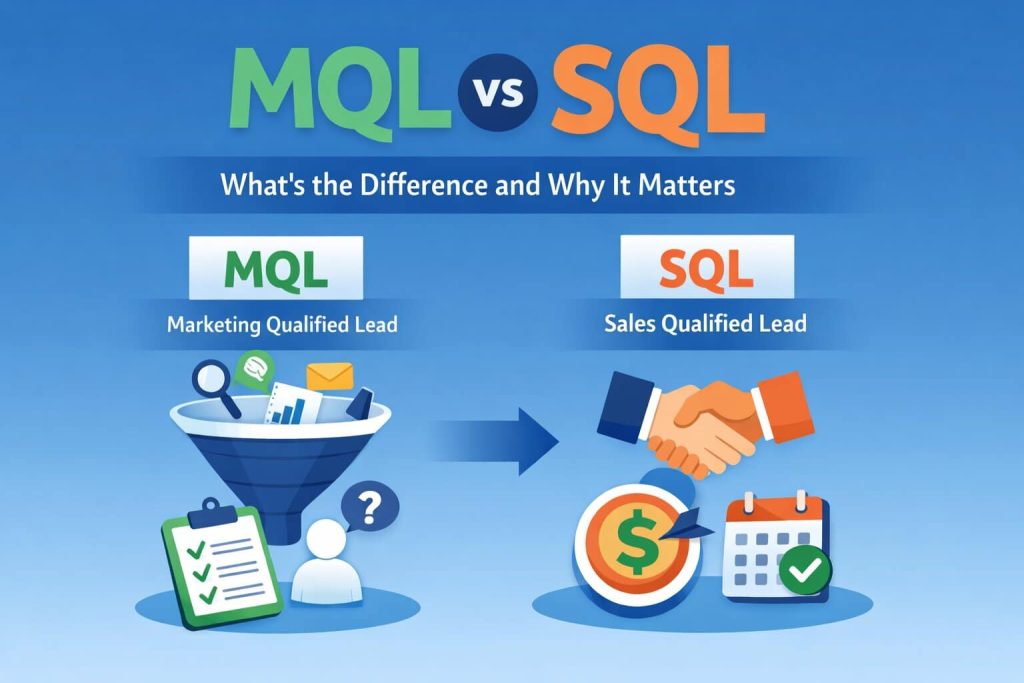
Here is a scenario that plays out in companies everywhere, every single quarter. The marketing team wraps up the month, pulls the numbers, and announces that they delivered 400 Marketing Qualified Leads. The CMO is thrilled. The VP of Sales, however, is not. She says the same thing she always says: most of those leads were not ready to buy, her team wasted hours chasing people who had no budget or no urgency, and the pipeline barely moved. The marketing team feels undervalued. The sales team feels unsupported. And somewhere in the middle, a significant amount of revenue potential quietly evaporates.
This story is not a failure of effort or intention. It is a failure of definition. When marketing and sales use the terms MQL and SQL without a shared, documented understanding of what each one actually means, they are operating from different maps of the same territory. They cannot agree on what a good lead looks like because they have never formally agreed on the criteria.
This guide is designed to end that confusion permanently. You will learn exactly what a Marketing Qualified Lead and a Sales Qualified Lead are, how they differ, how to define each for your own business, what the handoff process should look like, and why getting this right is one of the highest-leverage investments a revenue team can make. Whether you are a marketer, a salesperson, a founder, or a revenue operations professional, understanding MQL versus SQL is not just terminology – it is the foundation of a pipeline that actually works.
The Lead Qualification Landscape
Why Lead Qualification Exists
Not every person who interacts with your brand is equally likely to become a customer. Some visitors are genuinely curious about what you offer and are early in a buying process. Others are researchers, students, job seekers, or competitors doing reconnaissance. Still others were once interested but have moved on, or are in organisations that are simply not a fit for your product or service.
Lead qualification is the process of separating the signals from the noise. It is how you identify which of the hundreds or thousands of people in your database at any given time are actually worth your team’s time and attention. Without qualification, sales teams either pursue everyone – wasting enormous effort on poor-fit prospects – or pursue no one systematically, leaving valuable opportunities untouched.
The starting point for any qualification framework is a shared vocabulary. And that vocabulary begins with two terms that define the handoff between marketing and sales: the MQL and the SQL.
The Lead Journey at a Glance
Before defining MQL and SQL in depth, it helps to understand where they sit within the broader lead journey. A lead does not simply appear and then immediately become a customer. The journey typically looks like this:
| Stage | Who Owns It | What It Means | Primary Goal |
| Visitor | Marketing | Anonymous site visitor | Convert to known lead |
| Lead | Marketing | Contact info captured | Nurture and qualify |
| MQL | Marketing | Meets marketing criteria | Hand off to sales |
| SQL | Sales | Sales-ready, qualified | Open opportunity |
| Opportunity | Sales | Active deal in pipeline | Close the deal |
| Customer | Both | Closed-won deal | Retain and expand |
MQL and SQL are not the finish line of this journey – they are waypoints within it. Their importance lies in what they represent: the moment at which responsibility formally transfers from one team to another, and the moment at which a prospect’s likelihood of purchasing becomes high enough to justify direct sales investment.
What Is an MQL (Marketing Qualified Lead)?
The Definition
A Marketing Qualified Lead is a lead that the marketing team has assessed as more likely to become a customer than other leads in the database, based on a defined combination of who they are and what they have done. The key word in that definition is defined. An MQL is not simply a lead that marketing thinks looks promising – it is a lead that meets specific, documented criteria that have been agreed upon by both marketing and sales.
The distinction between an MQL and a regular lead is important. A lead is anyone who has given you their contact information – they downloaded a PDF, signed up for a newsletter, or filled out a form. That action alone does not tell you whether they are a serious buyer. An MQL, by contrast, has demonstrated a combination of profile fit and engagement behaviour that suggests they are worth a closer look. They have shown interest, but they have not yet been verified as ready for a sales conversation.
The Two Pillars of MQL Identification
Every strong MQL definition rests on two pillars: who the lead is, and what the lead has done. Neither pillar alone is sufficient. A perfect-profile prospect who has never engaged with your content is not ready for a sales call. A highly engaged contact who works for a five-person company when your minimum viable customer needs 200 employees is not worth a sales team’s time either. The combination of both signals is what makes a lead worth elevating to MQL status.
The first pillar – who the lead is – covers firmographic and demographic fit. This means asking whether the lead works at a company that matches your ideal customer profile in terms of industry, size, and geography, and whether the individual themselves has the role, seniority, or authority that typically characterises your buyers. A marketing manager at a 300-person SaaS company is a very different prospect from a freelance designer at a one-person studio, even if both downloaded the same guide.
The second pillar – what the lead has done – covers behavioural engagement signals. These are the actions a lead takes that indicate genuine interest beyond passive consumption. Visiting your pricing page is a strong intent signal. Downloading a detailed buyer’s guide suggests research mode. Attending a live product webinar signals active evaluation. Opening five consecutive emails in a nurture sequence suggests the content is resonating. Each of these actions, individually or in combination, adds weight to the case that a lead is ready to be reviewed by sales.
Common MQL Qualifying Actions
While every business should define its own MQL criteria based on its specific buyer journey, the following actions are widely recognised as strong MQL signals across B2B companies:
- Downloading a gated asset such as an eBook, whitepaper, or detailed industry guide
- Attending a live or on-demand product webinar or virtual event
- Visiting a high-intent page – pricing, features, demo request, or comparison – two or more times
- Engaging with three or more emails in a nurture sequence within a short window
- Returning to the website within seven days of an initial visit
- Submitting a contact form or live chat inquiry that includes a product question
- Reaching a defined lead score threshold in your marketing automation platform
What Is an SQL (Sales Qualified Lead)?
The Definition
A Sales Qualified Lead is a lead that the sales team has reviewed and confirmed meets the criteria for a direct sales conversation. Where the MQL answers the question “is this lead worth sales’ time?”, the SQL answers a more specific question: “has this lead confirmed the intent, fit, and readiness that justify opening a formal sales opportunity?”
The shift from MQL to SQL represents one of the most important transitions in the revenue process. At this point, a prospect moves from being a marketing responsibility to being a sales responsibility. They leave the nurture workflow and enter the pipeline. A sales representative takes direct ownership, an opportunity is opened in the CRM, and the full weight of the sales process – discovery, proposal, negotiation, closing – begins.
The BANT Framework: How SQLs Are Qualified
The most widely used framework for qualifying leads as SQLs is BANT, an acronym that stands for Budget, Authority, Need, and Timeline. Originating from IBM’s sales methodology, BANT provides a structured way for sales representatives to confirm whether a prospect genuinely meets the bar for a sales conversation.
Budget asks whether the prospect has the financial resources available to purchase your solution. This does not always mean an exact number – it might mean confirming they have an allocated budget for this category of software or service, or that they are in a position to request budget approval within a reasonable timeframe.
Authority asks whether the person you are speaking with has the power to make or meaningfully influence the purchasing decision. In many B2B organisations, the person who fills out a form is not the person who signs the contract. Qualifying authority means understanding who else is involved in the decision and whether your contact has access to those stakeholders.
Need asks whether the prospect has a genuine, specific problem that your product or service can solve. A company that is interested in your general category but does not have an active pain point is not yet SQL-ready. The need must be real, current, and clearly defined.
Timeline asks when the prospect intends to make a decision. A prospect who says “maybe next year” has a very different urgency level from one who says “we need to be live by end of quarter.” Timeline qualification helps sales prioritise their pipeline and avoid investing significant time in deals that are too early to move.
Beyond BANT: Modern Qualification Frameworks
While BANT remains the most widely recognised qualification framework, many modern sales organisations supplement or replace it with more nuanced approaches. The MEDDIC framework – which stands for Metrics, Economic Buyer, Decision Criteria, Decision Process, Identify Pain, and Champion – is increasingly popular in enterprise sales environments because it goes deeper into the organisational dynamics that drive complex purchasing decisions. CHAMP (Challenges, Authority, Money, Prioritisation) is another variation that puts the prospect’s challenges at the centre of the qualification conversation rather than starting with budget.
Regardless of which framework a business chooses, the underlying principle is the same: an SQL is not simply a lead who expressed interest. It is a lead who has been verified, through direct conversation or clear behavioural evidence, as a genuine prospect with the budget, authority, need, and timeline to make a purchase decision.
How SQLs Are Created: Two Distinct Paths
SQLs can arrive through two very different routes, and understanding both is important for building a complete lead qualification system.
The first path is inbound. An MQL is reviewed by a sales development representative or account executive, who conducts a qualification conversation – typically a short discovery call or a structured email exchange – to verify BANT criteria. If the lead meets the bar, the SDR accepts them as an SQL, opens an opportunity in the CRM, and either continues the conversation or assigns it to an account executive for deeper engagement. If the lead does not meet the bar, they are either recycled back into the marketing nurture sequence or disqualified entirely.
The second path is outbound. A salesperson identifies a target account, conducts cold outreach through email, phone, or LinkedIn, and during initial contact qualifies the prospect against defined SQL criteria. A prospect who responds to outbound outreach and confirms budget, authority, need, and timeline during an initial exchange can be immediately classified as an SQL, bypassing the MQL stage entirely because the qualification happened directly rather than through a marketing nurture process.
MQL vs SQL: The Core Differences
With both definitions established, the comparison becomes clear. The following table captures the most important distinctions across every relevant dimension:
| Dimension | MQL | SQL |
|---|---|---|
| Owner | Marketing team | Sales team |
| Stage in funnel | Middle of funnel (MOFU) | Bottom of funnel (BOFU) |
| Intent level | Interest confirmed | Purchase intent confirmed |
| Qualification basis | Demographic fit + engagement | BANT or equivalent criteria |
| Primary action | Nurture or hand off to sales | Open sales opportunity |
| CRM status | Lead/Contact (marketing stage) | Opportunity (sales pipeline) |
| Key question answered | Is this worth sales’ time? | Is this person ready to buy? |
| Determined by | Marketing, via scoring/criteria | Sales, via qualification call |
The simplest way to hold this distinction in mind is this: marketing creates MQLs, and sales creates SQLs. Marketing says “we believe this lead is ready for your attention.” Sales responds by investigating, qualifying, and either confirming or denying that readiness. When both teams operate from the same documented criteria, this exchange is smooth, efficient, and productive. When they do not, it becomes the source of one of the most persistent and costly conflicts in B2B business.
Why the MQL vs SQL Distinction Matters
The Cost of Getting It Wrong
When marketing and sales operate from different or undefined lead qualification criteria, the consequences are felt across the entire revenue operation. The most common failure mode is MQL criteria that are too loose – marketing passes a high volume of leads to sales, sales finds that most are not ready to buy, and trust between the two teams deteriorates. Sales stops taking MQLs seriously. Marketing stops feeling accountable for pipeline quality. And the company spends money generating leads that never contribute to revenue.
The opposite failure – MQL criteria that are too strict – is less common but equally damaging. When marketing holds leads back until they show extremely high engagement, genuinely interested prospects are over-nurtured and arrive at a sales conversation that should have happened weeks earlier. In competitive markets, this delay is enough to lose deals to vendors whose sales teams engaged sooner.
Undefined SQL criteria create a different problem. When there is no formal, agreed standard for what makes a lead sales-qualified, individual salespeople apply their own personal judgment about which leads to pursue. This creates enormous inconsistency in pipeline quality, makes accurate forecasting nearly impossible, and provides no data for improving the qualification process over time.
The Business Impact of Getting It Right
Companies that align on MQL and SQL definitions consistently outperform those that do not. The business case is straightforward. When marketing knows exactly what sales needs, they can focus their lead generation and nurturing activities on producing that specific outcome rather than optimising for volume. When sales knows exactly what an MQL means, they can engage with confidence, knowing that each lead in their queue has already been pre-screened against agreed standards.
The revenue operations impact is equally significant. Shared MQL and SQL definitions make pipeline reporting far more reliable because both teams are working from the same classification system. MQL-to-SQL conversion rates become a meaningful quality metric that bridges the two teams’ performance. Sales forecasting improves because the criteria defining each pipeline stage are consistent. And crucially, both marketing and sales can be held accountable for their respective contributions to revenue in a way that is transparent and fair.
How to Define MQL and SQL Criteria for Your Business
Start with Closed-Won Data
The most reliable way to define your MQL and SQL criteria is to work backwards from your best customers. Pull the last 20 to 30 closed-won deals from your CRM and examine them carefully. What did these customers have in common before they converted? What job titles did they hold? What company sizes did they represent? What actions did they take in the 30 days before they first spoke to a salesperson? What qualification signals appeared in the sales conversation that confirmed they were ready to buy?
The patterns you find in this data are the foundation of your qualification criteria. If your best customers consistently came from companies with 100 to 500 employees, that is a firmographic criterion for your MQL. If they consistently visited your pricing page before agreeing to a demo, that is a behavioural criterion. If the BANT conversation always revealed a defined budget and a 60-day decision timeline, those are your SQL standards.
Build Your MQL Scoring Model
Lead scoring is the mechanism by which marketing quantifies the combination of profile fit and engagement behaviour to determine when a lead has crossed the MQL threshold. The basic approach is to assign point values to specific attributes and actions, and to define a score at which a lead automatically becomes eligible for sales review.
A simple but effective starting framework might assign points as follows:
- Company size match (50–500 employees): 15 points
- Job title match (Manager, Director, VP, or C-suite): 20 points
- Pricing page visit: 20 points
- Gated content download: 15 points
- Webinar attendance: 20 points
- Demo page visit: 25 points
- Three or more emails opened in sequence: 10 points
A lead that accumulates 60 or more points might be automatically flagged as an MQL and routed to the sales queue. Negative scoring should also be applied to disqualifying signals – a personal Gmail address, a student job title, or a competitor domain can subtract points and prevent clearly unqualified contacts from reaching sales.
Document Your SQL Criteria Formally
SQL criteria should be written down, agreed upon by both marketing and sales leadership, and stored in a place where both teams can reference them easily. The document should specify the minimum BANT criteria required for a lead to be accepted as SQL, the time-to-response commitment for sales to follow up on MQLs, and the process for rejecting and recycling leads that do not meet the bar.
The rejection process deserves particular attention. When a salesperson decides that an MQL does not qualify as an SQL, they should be required to document the reason in the CRM using a standardised set of options – bad timing, no budget, wrong job title, company not a fit, and so on. This feedback loop is how marketing refines MQL criteria over time, and without it, the same types of low-quality leads will continue to arrive in the sales queue indefinitely.
Making the MQL-to-SQL Handoff Work in Practice
The handoff between marketing and sales is the moment where the MQL and SQL framework is either validated or exposed. A smooth, fast, well-documented handoff converts marketing’s work into sales momentum. A slow, poorly communicated, or ignored handoff wastes everything that came before it.
The Four Steps of an Effective Handoff
When a lead crosses the MQL threshold in your marketing automation platform, an automated notification should be sent immediately to the assigned sales development representative. This notification should include the lead’s full profile, their engagement history, their lead score breakdown, and a direct link to their CRM record. The SDR should not have to hunt for context – it should be waiting for them.
Within the agreed response time – best practice is 24 business hours or less – the SDR reviews the lead record and makes first contact. This initial outreach should be personalised to the lead’s specific engagement history. If they downloaded a guide on a particular topic, the opening message should reference that topic. Generic outreach at this stage wastes the context that marketing has carefully built and signals to the prospect that no one was paying attention.
The qualification conversation itself – whether conducted by phone, video call, or email exchange – should systematically work through BANT or your chosen equivalent framework. The goal is not to immediately pitch the product but to understand the prospect’s situation well enough to confirm whether they meet the SQL standard. If they do, an opportunity is opened and the lead advances. If they do not, the lead is recycled back to marketing with a documented reason.
Common Handoff Failures
Despite its apparent simplicity, the MQL-to-SQL handoff fails in predictable ways. The most common failure is slow follow-up. Research has consistently shown that the probability of connecting with a lead decreases dramatically with every hour that passes after they take a high-intent action. An SDR who follows up on a pricing page visit two days later is not simply less effective – they may be completely irrelevant, because the prospect has already moved on to a competitor who responded within an hour.
A second common failure is sales rejecting MQLs without providing feedback. When salespeople simply mark leads as unqualified and move on without documenting why, marketing loses the data it needs to improve. This silence reinforces the cycle: marketing keeps generating the same types of leads, sales keeps rejecting them, and the frustration between teams compounds. The fix is simple but requires discipline – every rejection must include a documented reason, and those reasons must be reviewed regularly by both teams.
Key Metrics to Track
A qualification framework is only as useful as the measurement system that surrounds it. Tracking the right metrics allows both marketing and sales to identify problems early, course-correct quickly, and demonstrate their respective contributions to pipeline and revenue.
The most important metrics for monitoring MQL and SQL health are:
- MQL Volume: The total number of MQLs generated per period. This measures marketing’s output but should always be evaluated alongside quality metrics, not in isolation.
- MQL-to-SQL Conversion Rate: The percentage of MQLs that sales accepts as SQLs. This is the primary indicator of lead quality and marketing-sales alignment. A well-aligned B2B company typically converts 13-25% of MQLs into SQLs.
- SQL-to-Opportunity Rate: The percentage of SQLs that become active pipeline opportunities. This measures sales qualification accuracy and helps identify if SQLs are being accepted prematurely.
- SQL-to-Close Rate: The percentage of SQLs that convert to closed-won customers. This is the ultimate quality measure – it tells you whether the leads entering the pipeline are genuinely worth pursuing.
- Time-to-SQL: The average time from first lead capture to SQL status. A long time-to-SQL may indicate that nurture sequences are too long, MQL criteria are too high, or leads are sitting unreviewed in the sales queue.
- Lead Recycle Rate: The percentage of MQLs rejected by sales and returned to marketing. A persistently high recycle rate is a clear signal that MQL criteria need tightening.
Frequently Asked Questions
Q1: What is the simplest way to explain the difference between an MQL and an SQL?
An MQL is a marketing verdict: this lead has shown enough profile fit and engagement signals that it deserves sales’ attention. An SQL is a sales verdict: this lead has confirmed enough budget, authority, need, and timeline to justify opening a formal sales opportunity. Marketing creates MQLs. Sales creates SQLs. One is about potential; the other is about confirmed readiness.
Q2: Who is responsible for converting an MQL into an SQL?
The conversion from MQL to SQL is a shared responsibility that falls squarely at the intersection of marketing and sales. Marketing is responsible for delivering MQLs that genuinely meet the agreed criteria – not inflating volume by passing marginal leads. Sales is responsible for reviewing MQLs promptly and conducting qualification conversations to confirm or deny SQL status. Neither team can succeed without the other. The MQL-to-SQL process only functions when both teams operate from the same documented definition and hold each other accountable to it.
Q3: How long should it take to convert an MQL into an SQL?
Best practice is for sales to make first contact with an MQL within 24 business hours. The full qualification conversation to determine SQL status typically takes one to three business days for most B2B businesses. The urgency of follow-up matters enormously – research consistently shows that response speed to high-intent lead actions is one of the strongest predictors of conversion. A prospect who visits your pricing page and receives a follow-up email within an hour is far more likely to engage than one who waits two days for a response.
Q4: Can a lead skip the MQL stage and go directly to SQL?
Yes, and this happens in two common scenarios. The first is a high-intent inbound action: when a prospect submits a demo request form, books a meeting directly through your website, or initiates a ‘contact sales’ inquiry, they have essentially self-qualified as SQL-ready and can bypass the MQL stage entirely. The second is outbound prospecting: when a salesperson conducts cold outreach and the prospect responds positively and confirms BANT criteria during the initial conversation, they can be classified directly as an SQL without ever passing through a marketing nurture sequence.
Q5: What is a good MQL-to-SQL conversion rate?
Industry benchmarks vary by sector, product complexity, and deal size, but a well-aligned B2B company typically converts between 13% and 25% of MQLs into SQLs. Conversion rates consistently below 10% suggest that MQL criteria are too loose and marketing is passing too many unqualified leads to sales. Rates above 40% may suggest that MQL criteria are too restrictive and good prospects are being held back longer than necessary. The target range for your specific business should be calibrated against your historical closed-won data rather than industry averages alone.
Conclusion
MQL and SQL are not just industry jargon or acronyms for marketing professionals to drop in strategy meetings. They are the contractual foundation of the relationship between marketing and sales – the shared language that allows two teams with different skills, different metrics, and different incentives to work toward the same revenue outcome.
When marketing knows exactly what an SQL requires and builds its MQL criteria to match, it stops optimising for lead volume and starts optimising for pipeline quality. When sales knows exactly what an MQL means and has agreed to review each one promptly and fairly, it stops treating inbound leads as an interruption and starts treating them as pre-qualified conversations. And when both teams measure themselves against shared metrics – MQL-to-SQL conversion rate, SQL-to-close rate, time-to-contact – they stop pointing fingers across the conference table and start solving problems together.
The place to begin is a single conversation. Get your marketing and sales leads in the same room – or on the same call – and do this one exercise: pull up your last 20 closed-won deals and ask what they had in common before they converted. What did those leads look like? What did they do? What did the qualification conversation confirm? The answer to those questions is your SQL definition. Work backwards from there to define your MQL criteria, agree on a scoring model, document the handoff process, and commit to a monthly review. It does not have to be perfect on the first attempt. It just has to be written down, agreed upon, and treated as a shared responsibility. Everything else follows from there.