
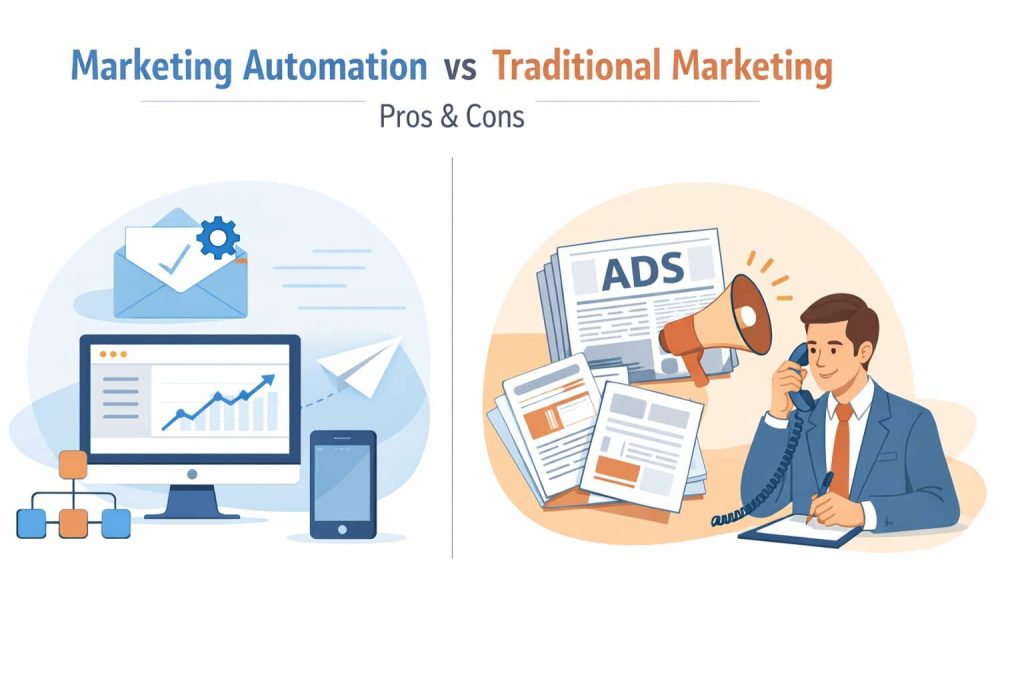
Imagine two founders sitting across from each other at an industry dinner. The first has built her retail brand over twenty years through print advertising, trade show presence, direct mail, and hard-won personal relationships with stockists. Her brand is trusted, recognised, and profitable. The second has grown his software company in six years almost entirely through email automation, paid acquisition, retargeting campaigns, and CRM-driven lead nurturing. He has never placed a print ad in his life. Both are successful. Both are convinced their approach is the better one.
This tension – between marketing automation and traditional marketing – sits at the centre of more strategic budget conversations than almost any other question in modern business. And yet the debate is rarely resolved with the clarity it deserves, because it tends to get hijacked by ideology on both sides. Digital advocates dismiss traditional marketing as expensive, unmeasurable, and obsolete. Traditional marketing defenders dismiss automation as cold, mechanical, and incapable of building the kind of deep brand relationships that sustain a business through a recession or a competitive disruption.
The truth, as with most genuine strategic questions, is more useful and more nuanced than either extreme. Marketing automation and traditional marketing are not rivals competing for the same job. They are tools built for different purposes, and the most effective marketing strategies in the modern era deploy both – thoughtfully, in proportion to their specific audience, objectives, and resources. This article provides a clear, honest, and balanced comparison of both approaches: what each one actually is, where each genuinely excels, where each genuinely falls short, and how to make a rational decision about which to prioritise, or how to combine them for maximum effect.
Defining the Two Approaches
Before comparing the two approaches meaningfully, it is worth establishing what each one actually is – not in caricature, but with the precision that a fair comparison requires.
What Is Traditional Marketing?
Traditional marketing refers to the collection of promotional methods that predate the internet and that a large number of businesses continue to use effectively today. It is defined primarily by its broadcast mechanic: a brand designs a message, selects a media channel, and delivers that message to an audience – largely passively and largely in one direction. The audience receives the message; the brand hopes the right members of that audience respond.
The channels that fall under the traditional marketing umbrella are broad and varied. They include print advertising across newspapers, magazines, and trade publications; broadcast advertising through television commercials and radio spots; out-of-home media such as billboards, transit advertisements, and poster campaigns; direct mail in the form of catalogues, postcards, and physical letters; event and trade show marketing involving in-person exhibitions and product demonstrations; and outbound prospecting through telemarketing, cold visits, and personal selling. What unites these diverse formats is that communication flows primarily from the brand to the audience, without the real-time feedback loop and individual responsiveness that digital channels provide.
The measurement challenge that defines traditional marketing is a direct consequence of this one-directional structure. Because you cannot track what each individual in the audience does after seeing your ad, performance measurement depends on estimation: circulation figures, audience ratings, footfall studies, and customer surveys. Attribution is approximate, feedback is slow, and the link between a specific creative execution and a specific sale is almost always inferential rather than direct.
What Is Marketing Automation?
Marketing automation is the use of software platforms to execute, manage, and optimise marketing activities automatically – based on rules, triggers, and contact-level data that a team defines in advance. Rather than manually sending each email, following up with each lead, or compiling each weekly report, the team configures the logic once and the platform carries it out at scale, responding to individual contact behaviour in real time without requiring human intervention at every step.
The range of capabilities that modern marketing automation platforms provide is substantial. They handle automated email sequences and drip campaigns triggered by specific user actions; lead capture through forms and landing pages with automatic CRM sync; lead scoring systems that rank contacts by purchase readiness based on demographic and behavioural data; website visitor tracking and retargeting campaign management; social media scheduling and audience management; A/B testing of messages and entire workflow paths; and detailed attribution reporting that connects specific campaign activities to specific revenue outcomes at the individual contact level.
What differentiates marketing automation from simply having an email newsletter tool is what could be called its intelligence layer: the ability to send different messages to different people based on who they are and what they have specifically done. A contact who opens an email but does not click receives a different follow-up than one who clicks but does not purchase, who receives a different sequence than one who purchased and is now a candidate for an upsell. This individual-level responsiveness, delivered simultaneously to thousands or millions of contacts, is what makes automation a fundamentally different category of marketing tool – not merely a faster version of what traditional broadcast methods accomplish.
Pros of Marketing Automation
Scalability Without Proportional Cost
The most structurally distinctive advantage of marketing automation is its cost behaviour at scale. Once a campaign is configured – the messages written, the logic defined, the triggers set, the integrations connected – it runs identically and at the same quality whether you acquire ten new leads in a week or ten thousand. The marginal cost of processing an additional lead through an automated sequence approaches zero. No additional human time is required. No additional media spend is necessary. The infrastructure cost remains essentially flat as volume grows.
This is a genuinely transformative economic proposition for a growing business. Research from the Annuitas Group found that businesses using marketing automation see 451% more qualified leads – a figure that reflects not just volume but quality, because automation can systematically nurture every lead through a structured educational journey, rather than relying on the inconsistent, capacity-constrained follow-up of a human sales team. The businesses that capture this advantage most effectively are those that invest in building their automation infrastructure early, allowing the compound interest of well-designed campaigns to accumulate as the business grows.
Personalisation at Scale
Traditional marketing, by its nature, sends the same message to everyone in its target audience. Demographic and geographic targeting narrows that audience, but within it, every person receives the same creative execution regardless of what they know, what they have done previously, or where they are in their decision process. Marketing automation inverts this model entirely by starting with the individual contact and constructing their experience from the specific data available about them.
Consider the difference in practice. A company launching a new product feature sends a single announcement email to its entire user base using a traditional broadcast approach. Using automation, it sends a different message to users who have already used a related feature (showing them an upgrade path), a different message to users who have never activated that area of the product (focusing on the value and a guided tutorial), and a different message to churned users for whom the new feature solves the problem that caused them to leave. All three campaigns run simultaneously, automatically, without a human scheduling each version. The result is not just personalisation in the superficial sense of using a contact’s first name in a subject line – it is contextual relevance, delivered precisely because the automation knows something specific and meaningful about each recipient.
Real-Time Measurement and Attribution
Every significant limitation of traditional marketing’s measurement model – the estimation, the inference, the slow feedback, the inability to attribute a specific sale to a specific touchpoint – is addressed by marketing automation’s data architecture. Every open, every click, every conversion, every revenue event is tracked at the individual contact level, attributed to the specific campaign and message that influenced it, and available in real time on a dashboard that any team member can access from anywhere.
This measurement clarity has profound implications for how a marketing team operates. When you know within 48 hours that a subject line test increased click-through rate by 18%, you can apply that insight immediately to the next campaign. When you know that message three in a seven-step nurture sequence is producing a 0.4% click rate – far below the sequence average – you can rewrite it, test an alternative, and deploy the improvement without waiting for a campaign cycle to end. The feedback loop that enables intelligent, data-driven optimisation is compressed from months to days, which means campaigns improve continuously rather than stagnating between periodic reviews.
Consistent and Timely Lead Nurturing
One of the quietest competitive advantages of marketing automation is what it removes from the equation: human inconsistency. When follow-up depends on a salesperson or marketing coordinator remembering to send a message, prioritising their workload, and having the time and energy to execute at a consistent quality across hundreds of concurrent leads, the result is inevitable variation. Some leads get excellent follow-up. Others slip through the gaps. The quality of a prospect’s experience with your brand depends partly on factors that have nothing to do with the prospect’s value – the day of the week, whether the team is at a conference, whether the responsible person is managing a particularly heavy week.
Automation removes all of these variables. Every lead enters a structured, well-timed sequence the moment they qualify, receives the same quality of messaging at the same intervals, and progresses through the journey according to their own behaviour rather than according to when a human happens to check their CRM. This is not just an operational convenience – it is a commercially significant advantage, because research on lead response time consistently shows that the probability of qualification drops dramatically with every hour of delay after initial contact. Automation ensures there is no delay.
Long-Term Cost Efficiency
The economics of marketing automation improve materially over time, and this trajectory is the inverse of most traditional media. The upfront investment is front-loaded: platform subscription, integration configuration, content creation for each stage of the journey, and the time required to build and test the initial workflows. These costs are real and should not be minimised. But once the campaigns are live and optimised, their variable cost of operation is negligible. Running the same campaign at twice the volume costs almost nothing incrementally.
Compare this to traditional advertising, where every incremental reach point requires proportionally more media spend. A direct mail campaign that reaches 10,000 contacts costs roughly twice as much to scale to 20,000. A television spot that runs in one market requires proportionally more production and media investment to expand to three markets. Automation’s cost structure – high fixed cost, very low variable cost – produces a strong and improving return on investment as the business grows, which is why it has become the operational foundation of almost every fast-scaling digital business.
Cons of Marketing Automation
Significant Setup Complexity and Learning Curve
The gap between signing up for a marketing automation platform and actually running effective campaigns through it is considerably wider than most teams anticipate. Building automation that performs well is not a plug-and-play activity. It requires a clear content strategy for every stage of the customer journey, well-designed audience segmentation logic, technical integration with existing CRM and data systems, configured triggers that fire reliably under the right conditions, and an ongoing discipline of monitoring, testing, and refinement. For organisations without a dedicated marketing operations professional – which includes most small businesses and many mid-sized companies – reaching operational maturity on a modern automation platform can take several months.
The consequences of getting the setup wrong are not benign. A sequence that fires a promotional email to customers who already purchased the promoted product, or a re-engagement campaign that accidentally enrolls active and engaged contacts, or a drip sequence with a broken unsubscribe link – these are not just operational embarrassments. They erode the trust and goodwill that motivated the contact to engage in the first place, and in some jurisdictions they create legal compliance risks under email marketing regulations. Automation amplifies execution at scale, which means errors scale along with successes.
The Risk of Impersonality at Scale
There is a deep irony at the heart of marketing automation: a tool designed to enable meaningful personalisation can, in the wrong hands, produce marketing that feels more impersonal than a mass-printed flyer. When segmentation is crude, when the underlying contact data is incomplete or outdated, and when no genuine thought has been invested in what a specific type of contact actually needs at a specific stage of their journey, the result is a torrent of automated messages that are technically addressed to the individual but emotionally relevant to no one.
The experience from the contact’s perspective is familiar and deflating: a welcome email that refers to them by their first name but recommends products they already own; a re-engagement campaign that arrives three days after they made a purchase; a birthday discount that fires for a product category they have never browsed. Each of these micro-failures signals the same thing – that the brand has their data but has not bothered to use it thoughtfully. The damage is not catastrophic in any single instance, but it accumulates. Automation’s promise is hyper-relevance; its risk is hyper-impersonality at hyper-speed.
Platform Costs and Vendor Lock-In
Quality marketing automation platforms carry meaningful subscription costs, and those costs scale with contact volume in ways that can generate budget surprises as a business grows. Entry-level tools start at $15 to $50 per month for small lists, but platforms suitable for growing businesses typically run $300 to $1,500 per month, and enterprise-grade solutions can cost significantly more. For a small or early-stage business, the subscription is manageable. For a mid-sized business managing a large contact base across multiple automated sequences, it becomes a substantial line item that requires ongoing justification.
The more significant concern for many businesses is vendor dependency. Marketing automation platforms become deeply embedded in operations over time: contact data, workflow logic, email templates, integration configurations, and performance history all accumulate within the platform. Migrating from one vendor to another – even when the motivation is legitimate, such as outgrowing the platform’s capabilities or finding a superior alternative – involves rebuilding this infrastructure from scratch. The switching cost is high enough that many businesses continue using platforms that no longer serve them well simply because the pain of migration exceeds the pain of suboptimal performance.
Dependence on Data Quality
Marketing automation is only as intelligent as the data it operates on. A contact database containing duplicate records, missing fields, incorrect segmentation tags, and stale behavioural data will produce automation that fires the wrong messages to the wrong people at the wrong time – regardless of how well the campaign logic itself is designed. Data hygiene is not a one-time setup task; it is a continuous operational discipline that requires regular deduplication, re-verification of contact information, audit of segmentation accuracy, and updating of lifecycle stage data as contacts move through the journey. Teams that neglect this discipline often find that their automation performs well at launch and degrades progressively as data quality deteriorates.
Limited Effectiveness in High-Touch, Complex Sales
For businesses with long, complex sales cycles involving multiple decision-makers, customised proposals, and significant relationship investment – a profile common in enterprise B2B sales – automation handles the top and middle of the funnel effectively but encounters its limits in the later stages. Understanding the specific dynamics of a procurement committee, adapting a proposal to address the idiosyncratic concerns of a particular buying organisation, reading the relational signals that indicate when to push and when to wait, and building the kind of personal trust that closes a high-value, high-risk purchase: these capabilities require human empathy, contextual intelligence, and relational judgement that no automation platform can replicate. In these contexts, over-reliance on automated sequences can actually reduce conversion rates by substituting templated communication for the responsive, adaptive human engagement that complex deals require.
Pros of Traditional Marketing
Unmatched Reach for Mass Brand Awareness
Television, radio, and large-format outdoor advertising retain a capability that targeted digital channels have not replicated at equivalent cost: the ability to reach genuinely broad audiences simultaneously with a shared brand experience. When the primary objective is not targeted lead generation but mass brand awareness – making a brand name familiar, recognisable, and credible across a wide population – traditional media at scale delivers a breadth of reach that digital channels simply cannot match without fragmenting the experience across hundreds of micro-targeted placements.
This is not nostalgia for a fading era; it is a structural reality of how certain media work. Consumer goods companies, automotive manufacturers, entertainment brands, and major retailers continue to invest billions annually in television, outdoor, and print advertising not because they lack access to sophisticated digital tools, but because these channels genuinely and measurably move brand awareness metrics in ways that no combination of social posts and email sequences can replicate. For brands that compete on recognition and mental availability – where being top-of-mind at the moment a purchase decision is made is the primary commercial driver – traditional media remains a core strategic investment, not a legacy habit.
Higher Perceived Credibility and Consumer Trust
Research consistently and counterintuitively finds that consumers trust certain traditional advertising formats more highly than their digital counterparts. Nielsen’s Global Trust in Advertising research has for years ranked television, print, and direct mail among the most trusted advertising formats, outperforming online banner ads, social media advertising, and search advertising on trust metrics by significant margins. Part of this reflects familiarity and habit; part of it reflects a genuine perception that a company willing to invest in premium media – a double-page magazine spread, a network television spot, a high-production-value direct mail piece – is signalling financial stability, commitment, and legitimacy in a way that a $50 Facebook boosted post does not.
For businesses operating in high-trust categories, this credibility premium carries real commercial value. A patient evaluating a healthcare provider, a client selecting a financial adviser, an individual choosing a law firm – these are consequential decisions made under uncertainty, and the trust signals embedded in established media carry genuine weight in the evaluation process. In these contexts, traditional advertising is not just a channel choice; it is a trust architecture decision that shapes how the brand is perceived before the first direct interaction occurs.
Tangibility and the Power of Physical Presence
Physical marketing materials create a sensory experience that screen-based media cannot replicate. A well-produced brochure has weight, texture, and a permanence that a landing page does not possess. A trade show demonstration allows a prospect to see, touch, and interact with a product in three dimensions, in a social context that activates different emotional and cognitive responses than a product video viewed alone on a laptop. A carefully designed direct mail package sits on a desk for days, re-entering the recipient’s awareness each time they pass it – a form of persistent brand presence that an email buried in an inbox cannot achieve.
There is a counter-intuitive dynamic at work in direct mail specifically: as digital inboxes have become more crowded and email open rates have declined, the physical letterbox has become less cluttered and therefore more attention-rich. Direct mail response rates have increased in the past decade as consumers have become habituated to digital messaging and more responsive to the relative scarcity of physical communication. The novelty and effort signalled by a thoughtfully produced physical piece – the fact that someone bothered to print, package, and post it – creates a positive impression that a digital equivalent, however well-designed, rarely generates.
Effectiveness for Local and Offline-Primary Audiences
The argument for digital-first marketing rests on the assumption that the target audience is meaningfully reachable online. For many businesses, that assumption does not hold. Local service businesses serving predominantly older demographics, professional service firms in sectors where relationships are built through in-person networking, rural businesses operating in communities with limited digital infrastructure, and product companies targeting populations with low smartphone adoption all encounter situations where the most cost-effective way to reach their actual customers is through the channels those customers actually use – which often means local radio, community newspapers, direct mail, and in-person events. Traditional marketing, in these contexts, is not a second-best option reluctantly deployed in the absence of a better digital alternative. It is the most effective available channel.
Cons of Traditional Marketing
Limited Targeting Precision
The structural limitation of traditional marketing’s broadcast model is that it cannot filter its audience by the signals that matter most to a marketer: purchase intent, stage in the buying journey, past behaviour with the brand, or specific information needs at a specific moment. A magazine advertisement reaches every reader of that issue – the ideal prospect who is actively evaluating competing options, the loyal customer who already purchased last month, the reader who will never be in the market for the product, and every gradation of relevance in between. The only precision available is the demographic and psychographic profile of the publication’s general readership, which is a coarse approximation of the targeting that digital channels make available at a granular level.
This imprecision has a direct cost implication: a significant and often dominant proportion of every traditional media budget is spent reaching people who have no meaningful probability of converting. This is not a failure of execution; it is a structural feature of the broadcast model. And while the economics of traditional media have historically been justified by the low cost-per-thousand-impressions of channels like broadcast television, the comparison with precision-targeted digital channels that pay only for the impressions most likely to convert makes traditional media’s efficiency picture increasingly complex to defend on pure performance grounds.
Difficult Measurement and Slow Performance Feedback
The inability to directly attribute business outcomes to specific traditional marketing activities is not merely an academic inconvenience – it has material consequences for how marketing budgets are managed, how campaign performance is evaluated, and how strategic decisions are made. When you cannot trace a specific purchase back to a specific ad impression, you cannot confidently know whether your current campaign is working, which of two competing campaigns is working better, or what proportion of your current media spend is generating commercial value versus creating awareness that never converts to revenue.
The feedback loops available in traditional marketing are slow by the standards of digital optimisation. A print advertisement placed in a monthly publication cannot be revised until the next issue cycle. A television campaign’s brand lift metrics are typically measured in the weeks and months after the campaign concludes. A direct mail campaign requires the physical logistics of printing, posting, and allowing response time before meaningful performance data accumulates. By the time you have enough information to make a confident optimisation decision, the campaign may have already consumed a significant proportion of its total budget.
High Costs and Inflexible Commitments
Premium traditional media placements carry costs that are both high in absolute terms and inflexible in structure. Production of a broadcast-quality television commercial requires substantial investment before a single impression is served – scriptwriting, casting, filming, editing, and post-production can cost tens or hundreds of thousands of pounds or dollars for a national-quality execution. Magazine and newspaper advertising placements require creative materials to be submitted weeks ahead of publication, with no mechanism for adjustment once the issue goes to press. Outdoor advertising campaigns must be committed to media vendors months in advance with display periods fixed at booking.
This structural inflexibility compounds the performance measurement problem. Even if a brand receives early signals that a campaign is not resonating as expected – through social media sentiment, early sales data, or direct customer feedback – there is often no practical ability to adjust the campaign mid-flight. The media runs, the creative is fixed, and the budget is committed. Digital marketing’s ability to pause, adjust, reallocate, or entirely replace a campaign within hours is a capability that traditional media simply cannot match.
Poor Scalability
Scaling a traditional marketing programme requires proportionally more investment at almost every level of the growth curve. Reaching twice as many people requires buying roughly twice as much media. Adding three new geographic markets requires producing market-specific creative variations and purchasing media in each market separately. Increasing message frequency requires additional placements at additional cost. There is no equivalent to automation’s flat marginal cost structure, where volume can be doubled without doubling the budget. For businesses pursuing rapid or exponential growth, the linear cost scaling of traditional marketing creates a ceiling effect that makes it structurally unsuited as the primary growth engine.
Head-to-Head Comparison
The table below summarises how both approaches compare across the dimensions that most commonly influence marketing strategy decisions. It is intended as a decision-support tool rather than a scorecard – the right answer in each row depends on the specific context of your business, audience, and objectives.
| Dimension | Marketing Automation | Traditional Marketing |
| Cost structure | High fixed (platform); very low marginal cost at scale | Variable – every additional impression costs more |
| Targeting precision | Very high – behavioural, intent-based, demographic | Low to moderate – broad audience reach |
| Measurability | Real-time, contact-level attribution | Indirect; estimated reach and slow feedback loops |
| Scalability | High – volume scales without proportional cost | Linear – more reach requires proportionally more budget |
| Brand awareness | Moderate – targeted reach within defined segments | High – mass reach, broad simultaneous exposure |
| Trust and credibility | Moderate – depends strongly on execution quality | High – established media carry perceived authority |
| Personalisation | Very high at scale – responds to individual behaviour | Very low – same message delivered to all |
| Setup complexity | High – platform config, content, and integration required | Moderate – production complexity varies by channel |
| Best suited for | Lead nurturing, digital audiences, scalable growth | Mass awareness, high-trust categories, local or offline audiences |
How to Choose the Right Approach for Your Business
Given the genuine strengths and limitations of both approaches, the decision framework should not be a binary choice between automation and traditional marketing, but a structured analysis of where each approach delivers the most value for your specific situation. Three questions guide this analysis most usefully.
When Marketing Automation Should Lead Your Strategy
Marketing automation is the right primary strategy when your audience makes decisions through digital channels – when they research products online, evaluate options through email content, and convert through digital touchpoints. It is also the right lead strategy when your business model depends on converting a high volume of leads through a structured, multi-step educational journey, when your team is small relative to the number of contacts you need to nurture, and when you need granular real-time data to make rapid, confident resource allocation decisions.
The business types that consistently benefit most from automation as their primary marketing infrastructure include SaaS companies, e-commerce brands, B2B professional services firms, online education providers, financial services companies, and real estate agencies. What these businesses share is a digitally active audience, a multi-stage buying journey with clear decision points, and a need to manage lead nurturing at a volume that makes manual follow-up operationally impossible.
When Traditional Marketing Should Lead Your Strategy
Traditional marketing should remain the primary channel strategy when your core audience is not meaningfully reachable or persuadable through digital channels – when they are older, less digitally engaged, or making decisions through in-person relationships rather than online research. It is also the right lead strategy when the primary commercial objective is broad brand awareness rather than targeted lead generation, when you operate in a regulated or high-trust category where media credibility genuinely influences the buying evaluation, and when your product or service benefits from physical demonstration, sensory experience, or the weight of established media association.
Local service businesses, consumer packaged goods brands, healthcare providers, legal and financial services firms, luxury goods companies, and event-driven businesses frequently find that traditional channels deliver superior primary returns for their specific audiences and competitive contexts – not because they are behind the times, but because their audiences and the nature of their offering make traditional channels genuinely more fit for purpose.
The Integrated Approach: Why Most Businesses Should Use Both
For most businesses operating above a certain scale and complexity, the most strategically sound framing is not automation or traditional, but automation and traditional, each deployed where it is strongest. The two approaches are not competing for the same job. Traditional marketing is exceptionally good at generating broad awareness, establishing credibility through established media, and reaching audiences that digital channels cannot access. Marketing automation is exceptionally good at capturing the interest that awareness generates, nurturing it through a structured journey, and converting it into measurable revenue. Together, they cover the full arc of the customer journey in a way that neither can achieve in isolation.
The practical integration looks like this: a television commercial drives a wave of branded search queries, and automation captures those visitors through a retargeting sequence and email opt-in flow. A trade show generates two hundred business card contacts, and automation enrolls them in a thirty-day nurture sequence that systematically builds on the in-person conversation. A direct mail piece reaches ten thousand prospects, and a QR code routes respondents into a personalised digital journey that automation manages from that point forward. In each case, traditional marketing generates the awareness and credibility that makes the subsequent automated engagement meaningful. Automation converts that meaning into revenue with a precision and consistency that traditional follow-up never could.
The most practical starting point for businesses evaluating this integration is an honest audit of their current marketing mix. Identify where awareness is being generated that is not being systematically converted – that gap is where automation typically delivers its fastest return on investment. Identify where your audience is not reachable through digital channels – that gap is where traditional media continues to justify its place in the budget. Build from that diagnosis rather than from ideology about which approach represents the future.
Frequently Asked Questions
Is marketing automation better than traditional marketing?
Neither approach is universally better, and the question itself reflects a framing error. Marketing automation outperforms traditional marketing on targeting precision, real-time measurability, scalability, and the economics of lead nurturing at volume. Traditional marketing outperforms automation on mass brand awareness reach, consumer trust, tangibility, and effectiveness with offline-primary audiences. The most successful marketing programmes use both approaches in proportion to where each delivers the most value for the specific business context. Declaring one categorically superior misunderstands the distinct jobs each is designed to accomplish.
Can small businesses afford marketing automation?
Yes, and the accessibility of entry-level automation has increased significantly. Platforms like Mailchimp offer meaningful automation capabilities for free for small contact lists, and HubSpot’s free CRM tier includes basic workflow automation at no cost. Paid entry-level plans across most major platforms start at $15 to $30 per month – a cost that is typically recovered within weeks by the time savings on manual follow-up alone. The more honest constraint for most small businesses is not the subscription cost but the time required to configure the platform effectively and create the content needed for each stage of the automated journey. Starting with one well-designed workflow rather than attempting full-scale automation from day one is the approach most likely to produce early returns.
Does traditional marketing still work in a digital-first world?
Emphatically yes, and dismissing it as obsolete is a mistake that has cost several digitally-focused brands significant market share. Direct mail response rates have risen over the past decade as email open rates have declined, because a physical piece of mail in a less-crowded letterbox stands out in a way that the five-hundredth email in an inbox does not. Television advertising continues to drive measurable brand lift and purchase intent for consumer brands at scale. Trade shows consistently rank among the highest-ROI lead generation channels for B2B businesses whose buyers attend them. The question is not whether traditional marketing works – it is whether it works for your specific audience, objective, and budget.
What is the biggest disadvantage of marketing automation?
The biggest single risk is producing impersonal, contextually irrelevant communications at scale when the strategy behind the automation is underdeveloped. Automation executes the strategy it is given with high fidelity and high volume. A thoughtful strategy becomes more powerful when automated. A poorly conceived strategy becomes more damaging because it reaches more people more efficiently. The practical implication is that the quality of thinking required before building automation – audience segmentation, journey mapping, content strategy, data quality planning – is higher than most teams anticipate, and underinvesting in that thinking is the most common reason automation programmes underperform or fail.
How does marketing automation ROI compare to traditional marketing?
Marketing automation typically delivers stronger measurable return on investment for conversion-focused campaigns because every action is tracked and attributable. Research from Nucleus Research found that automation increases sales productivity by 14.5% and reduces marketing overhead by 12.2%. Traditional marketing ROI is structurally harder to measure, but this measurement difficulty does not mean the return does not exist – it means it is harder to capture in a dashboard. Brand equity and consumer trust built through traditional media generate downstream revenue effects that standard digital attribution models systematically undervalue. A more complete view of ROI comparison would recognise that automation tends to deliver better short-to-medium-term measurable returns on conversion investment, while traditional media often delivers better long-term returns on brand equity that makes all subsequent marketing – including automation – more efficient.
What industries benefit most from marketing automation?
SaaS companies, e-commerce brands, B2B professional services firms, financial services businesses, real estate agencies, and healthcare providers (for patient education and appointment management) consistently report strong returns from marketing automation. These industries share the characteristics that make automation most powerful: digitally active audiences, multi-step buying journeys with defined decision stages, high lead volumes that benefit from systematic nurturing, and clear conversion events that can be tracked and attributed. Industries with shorter impulse-driven purchase cycles, predominantly offline audiences, or sales processes dominated by personal relationships – local trades, hospitality, luxury retail, traditional professional services – often find that their primary channel value lies in traditional approaches, with automation playing a supporting rather than a lead role.
Should I replace traditional marketing with automation, or add automation on top?
In almost every circumstance, the answer is to add automation on top of – not in place of – existing traditional marketing. The businesses that have abandoned all traditional marketing in favour of digital automation frequently discover, sometimes acutely, that they have dismantled the awareness-generation infrastructure that fed their lead pipeline. Digital-only brands operating in competitive consumer categories often find that brand awareness plateaus as the performance marketing channels they rely on become more competitive and more expensive, and that the brand trust deficit created by years without traditional media presence makes customer acquisition progressively harder. The most effective transitions begin by using automation to capture and convert the interest that existing traditional marketing generates – then, once the automation infrastructure is performing well, using the data it produces to make more intelligent decisions about which traditional channels to maintain, scale, or redirect.
Conclusion
The debate between marketing automation and traditional marketing is, at its core, a debate about tools, and tools do not have inherent superiority independent of the job they are asked to do. Marketing automation is an exceptional tool for nurturing leads at scale, personalising the customer experience across a complex multi-step journey, measuring performance with precision, and building marketing infrastructure that compounds in value as a business grows. Traditional marketing is an exceptional tool for building broad brand awareness, establishing credibility through established media, creating physical brand experiences that digital channels cannot replicate, and reaching audiences that live primarily offline.
Neither approach, deployed in isolation, covers the full range of what an effective marketing programme needs to accomplish. Automation without awareness generation is a highly efficient engine with nothing to feed it. Traditional marketing without systematic digital follow-up leaves a significant proportion of the interest it generates unconverted, largely invisible in the performance data, and ultimately unmeasured. The businesses that consistently outperform their competitors in customer acquisition and retention are those that treat this not as an either/or choice, but as a both/and architecture – using traditional channels to build the brand and awareness that automation then captures, nurtures, and converts with precision.