
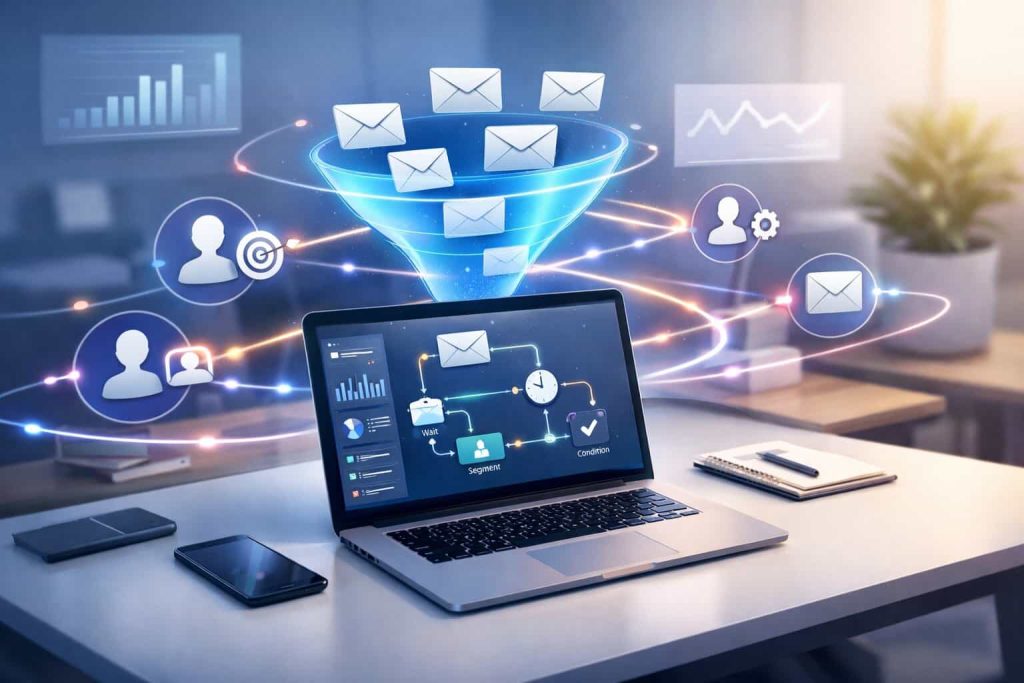
Most businesses treat email marketing as something that requires constant effort. They write a broadcast, send it to their list, watch the results for a day or two, and then repeat the cycle all over again the following week. While broadcast emails have their place, this approach misses the most powerful capability email has to offer: the ability to work for you around the clock, delivering the right message to the right person at exactly the right moment, without any ongoing manual effort.
Automated email sequences change the economics of email marketing entirely. Instead of trading your time for each campaign, you invest time once to build a sequence and then let it run indefinitely, converting new subscribers, recovering abandoned carts, winning back lapsed customers, and nurturing leads toward purchase every single day. Businesses that have invested in well–built automated sequences consistently report higher conversion rates, stronger customer retention, and significantly lower cost per acquisition compared to those relying solely on manual campaigns.
The challenge is that most automated sequences are built poorly. They are either too generic to feel relevant, too sales–heavy to build trust, or technically misconfigured so that subscribers fall through the cracks. The goal of this guide is to give you a complete, practical framework for building automated email sequences that actually convert, from choosing the right sequence type for your goal to writing copy that earns clicks and measuring results over time.
What Are Automated Email Sequences and Why Do They Convert?
An automated email sequence, sometimes called a drip campaign or email flow, is a series of pre–written emails sent automatically to a subscriber based on a specific trigger event or their position in a journey. Unlike a broadcast email that goes to everyone on your list at a scheduled time, a sequence is personal. It begins when an individual subscriber takes a specific action, such as signing up for your newsletter, downloading a lead magnet, abandoning a shopping cart, or making a purchase, and then walks them through a carefully designed series of messages designed to achieve a defined outcome.
The mechanics are straightforward. You write the emails in advance, configure the triggers and delays in your email platform, and the system handles delivery automatically. Subscriber A might enter your welcome sequence on a Tuesday morning, while subscriber B enters the same sequence on a Friday afternoon. Each of them moves through the emails at their own pace, receiving each message at the interval you set, without you lifting a finger after the initial setup.
Why Sequences Outperform Single Emails
The reason automated sequences convert at higher rates than single emails comes down to a fundamental truth about human psychology: trust is built through repeated, consistent, relevant contact over time. A first–time subscriber who receives a single promotional email from a brand they just discovered is unlikely to buy. They do not know you, they have not yet experienced your value, and the timing of the ask almost certainly does not align with where they are in their decision–making process.
A well–constructed sequence addresses all three of these barriers. It introduces your brand and establishes credibility in early emails. It delivers genuine value, through useful content, insights, or practical guidance, so the subscriber experiences your expertise before being asked to spend money. And it times the sales–oriented emails for later in the sequence, when trust has been established and the subscriber is far more receptive to an offer. This mirrors the natural progression of any good sales conversation: listen, educate, demonstrate value, then propose.
Sequences vs. Broadcast Emails: Using Both Strategically
Understanding the distinction between sequences and broadcast emails is important because the two serve different purposes and work best when used together. Broadcast emails are ideal for time–sensitive content like product launches, seasonal promotions, company news, and weekly newsletters. They require ongoing effort but keep your list engaged with current, timely information. Automated sequences handle everything else: onboarding new subscribers, nurturing prospects toward their first purchase, recovering abandoners, and re–engaging inactive contacts. Together, they form a complete email marketing system where sequences handle the always–on foundational work and broadcasts add timely momentum on top.
The Five Most Powerful Types of Automated Email Sequences
Before building any sequence, you need to choose the right type for your goal. Different sequences serve fundamentally different purposes and require different approaches to copy, timing, and structure. The five types below represent the highest–converting, most widely applicable sequences for businesses across industries.
The Welcome Sequence
The welcome sequence is the single most important automated email series you will ever build. It is triggered the moment someone joins your list, which is the period of highest interest and attention a new subscriber will ever have toward your brand. Research consistently shows that welcome emails generate open rates several times higher than average marketing emails, yet many businesses either skip the welcome sequence entirely or reduce it to a single confirmation email and nothing more.
A strong welcome sequence typically runs three to five emails over the first seven to ten days and accomplishes several goals simultaneously. It delivers on whatever promise prompted the signup, whether that was a lead magnet, a discount code, or simply access to your content. It introduces your brand’s story, values, and what makes you different in a way that creates genuine connection rather than just corporate positioning. And it begins delivering value immediately, giving the new subscriber a reason to keep opening your emails before any purchase ask is ever made. By the final email in the sequence, the subscriber should feel oriented, informed, and genuinely interested in what you offer, making any offer you present feel like a natural next step rather than an interruption.
The Nurture Sequence
Not every subscriber is ready to buy when they first join your list. Some are in the early stages of researching a problem. Others are evaluating multiple options. Still others know they eventually want to make a purchase but need time and information before they feel confident committing. The nurture sequence is designed specifically for these subscribers, keeping them engaged and moving steadily toward a purchase decision without rushing or pressuring them.
A well–designed nurture sequence is primarily educational rather than promotional. It positions you as a trusted authority by sharing insights, frameworks, case studies, and practical guidance that genuinely help the subscriber with the problem your product or service solves. The sales–oriented content comes later in the sequence, once credibility has been firmly established. Nurture sequences typically run five to ten emails over two to four weeks and are most valuable for businesses with longer consideration cycles, such as B2B software, high–ticket services, and complex consumer products.
The Cart Abandonment Sequence
Cart abandonment is one of the most expensive problems in e–commerce. Industry data consistently shows that the majority of online shopping carts are abandoned before checkout is completed, representing billions of dollars in potential revenue that simply evaporates. The cart abandonment sequence is specifically designed to recover as much of that revenue as possible by re–engaging shoppers who demonstrated strong purchase intent but did not complete the transaction.
The sequence typically consists of three emails sent over three to five days. The first email, sent one to two hours after abandonment, is a simple, friendly reminder showing the items left behind and making it easy to return to checkout. The second email, sent around 24 hours later, goes deeper: it addresses common objections to purchasing, highlights reviews or testimonials, reinforces guarantees or return policies, and reminds the shopper why they were interested in the first place. The third email, sent 48 to 72 hours after abandonment, introduces a sense of urgency or a limited incentive such as a small discount or free shipping offer to tip hesitant buyers into completing their purchase.
The Post–Purchase Sequence
The sale is not the end of the customer relationship. It is the beginning of it. Businesses that treat email automation as a pre–purchase tool only are leaving a tremendous amount of value on the table. The post–purchase sequence begins immediately after a customer completes a transaction and serves several critical functions: it reduces buyer’s remorse by reinforcing the quality of the decision they just made, it improves the customer experience by providing useful onboarding or product guidance, it generates social proof through timely review requests, and it opens the door to repeat purchases through strategic cross–sell and upsell recommendations.
A strong post–purchase sequence feels less like marketing and more like exceptional customer service. Its tone should be warm, helpful, and genuinely focused on ensuring the customer gets maximum value from their purchase. The commercial asks, whether for a review, an upsell offer, or a referral, should feel earned through the value delivered in earlier emails rather than bolted on as an afterthought.
The Re–Engagement Sequence
Every email list has a segment of subscribers who have gone quiet. They joined at some point in the past, perhaps opened your first few emails, and then gradually stopped engaging. These inactive subscribers represent both an opportunity and a risk: an opportunity because they already expressed enough interest to sign up, and a risk because continuing to send emails to a large, disengaged segment damages your sender reputation and reduces deliverability for your entire list.
The re–engagement sequence is a targeted, empathetic campaign designed to either rekindle the subscriber’s interest or give them a graceful way to exit the list. It typically runs three emails over one to two weeks and strikes a tone that is direct and honest rather than gimmicky. The best re–engagement emails acknowledge the silence, offer something genuinely compelling to restart the relationship, and make it clear that the subscriber has a choice about whether to continue receiving emails. This honesty is both ethically sound and strategically smart: it preserves your list’s quality and protects the deliverability that your active subscribers depend on.
How to Build an Automated Email Sequence Step by Step
Understanding the different types of sequences gives you the what. The following six–step process gives you the how. Working through these steps in order, rather than jumping straight to writing, is what separates high–converting sequences from ones that underperform despite good intentions.
Step 1: Define a Single, Clear Conversion Goal
Every sequence must be built around one specific outcome. Not multiple outcomes, not a general desire to stay in touch, but a single, measurable conversion goal. For a welcome sequence, that goal might be a first purchase or a booked discovery call. For a nurture sequence, it might be a free trial signup. For a cart abandonment sequence, it is completing the purchase. Clarity on this goal shapes every decision that follows: what emails to write, what content to include, when to introduce an offer, and how to measure success.
Before writing a single word, articulate your goal in a specific, outcome–oriented sentence: ‘This sequence exists to convert new subscribers into first–time buyers of our core product within 10 days of signup.’ That level of specificity focuses the sequence and prevents the common trap of trying to achieve too many things at once, which consistently produces sequences that accomplish nothing particularly well.
Step 2: Define Triggers, Entry Conditions, and Exit Conditions
The technical architecture of your sequence is as important as the content within it. A trigger is the specific event that enrolls a subscriber into the sequence. Common triggers include form submissions, tag applications, purchase events, page visits, link clicks, and date–based conditions. Entry conditions add further specificity to who gets enrolled: you might trigger a sequence for all form submissions, but use entry conditions to restrict it to subscribers who signed up via a specific landing page or who do not already have a certain tag on their profile.
Exit conditions are equally critical and are one of the most frequently overlooked aspects of sequence architecture. An exit condition is the event that removes a subscriber from the sequence before they reach the final email. If someone is in a nurture sequence and makes a purchase before email seven, they should immediately exit the nurture flow and enter a post–purchase sequence instead. Failing to configure proper exit conditions means subscribers receive contextually inappropriate emails, which damages trust, increases unsubscribes, and undermines the entire purpose of personalized automation.
Step 3: Map the Email Flow Before Writing
Resist the urge to open your email platform and start drafting immediately. Before writing a single email, map the entire sequence on paper or in a simple document. For each email in the sequence, define its position number, its primary job in the sequence, the core message it needs to deliver, and the single call to action it will include. This map becomes both a writing guide and a quality control tool that helps you ensure each email is doing a distinct, necessary job and that the sequence as a whole builds logically toward the conversion goal.
Pay particular attention to the emotional arc of the sequence. Early emails should feel welcoming and generous, primarily focused on delivering value rather than selling. The sequence should earn the right to make a commercial ask by consistently delivering on its promises in the emails that precede the offer. When a purchase request feels like a natural conclusion to a genuinely valuable series of emails rather than an interruption, conversion rates reflect that alignment.
Step 4: Write Each Email with One Focus
The most common structural mistake in email copywriting is trying to cover too much ground in a single email. Every email in your sequence should have one topic, one primary message, and one call to action. This constraint feels restrictive at first but reliably produces better–performing emails because subscribers always know exactly what they are being asked to read and what action they are being invited to take.
When writing each email, pay particular attention to the subject line and the opening sentence. The subject line’s job is to earn the open, and it should promise something genuinely interesting, useful, or relevant to that specific subscriber at that specific point in their journey. The opening sentence’s job is to earn the second sentence, and the most reliable way to achieve this is to open with something that speaks directly to the subscriber’s world: a problem they recognize, a desire they feel, or a situation they are currently navigating. From there, deliver on the subject line’s promise in the body, and close with a clear, specific call to action that flows naturally from the content rather than feeling appended as an afterthought.
Step 5: Configure and Test the Automation Logic
Once your emails are written, the technical setup begins. Configure your triggers, delays, entry conditions, exit conditions, and any behavioral branching in your email platform. If your sequence includes conditional paths, such as sending one email to subscribers who clicked a specific link and a different email to those who did not, build and test each path independently.
Testing before launch is non–negotiable. Manually trigger the sequence using a test email address and walk through every email, verifying that each one sends at the correct time, that personalization tokens such as first name fields populate correctly, that all links function as expected, and that exit conditions work properly. Simulate a conversion event mid–sequence and confirm that the subscriber exits the appropriate sequence and enters the correct next flow. This testing investment takes an hour or two but prevents the kind of errors that silently undermine a sequence’s performance for months.
Step 6: Launch, Monitor, and Iterate
After launching your sequence, monitor performance closely during the first two to four weeks. Pay attention to which emails have noticeably lower open rates than the others, as this often signals subject line issues or delivery timing mismatches. Track click–through rates by email to identify where engagement drops, which points to content relevance or CTA clarity problems. Watch unsubscribe rates by email position, since a spike at email two or three often indicates the sequence is moving too aggressively toward a sales pitch before trust has been established.
Treat your sequence as a living asset rather than a finished product. The initial version is a starting point. As performance data accumulates, run A/B tests on subject lines, adjust email timing based on engagement patterns, and refine the copy of underperforming emails. Sequences that are actively maintained and improved over time compound in performance, becoming progressively more effective as you learn what resonates with your specific audience.
Writing Email Copy That Converts at Every Stage
Knowing what to write is not enough. The way you write it determines whether subscribers read to the end, click through, and ultimately convert. High–converting email copy is not just good writing in the general sense. It is writing that understands where the subscriber is in their journey, speaks directly to what they care about, and makes the action you want them to take feel natural and worthwhile.
The Anatomy of a High–Converting Email
Every email in your sequence consists of the same structural components, and each one carries its own weight in the conversion equation. The subject line is the most consequential line you will write because it determines whether everything else gets read. The best subject lines are specific rather than vague, relevant to what the subscriber cares about at that moment, and carry either a clear benefit, genuine curiosity, or a direct connection to a conversation the subscriber is already having in their own mind.
The preview text is the second subject line and is underused by most marketers. Rather than letting your email platform pull the first line of the email body, write a custom preview text that extends or reinforces the subject line’s hook. Together, the subject line and preview text should make the subscriber feel that opening the email is clearly worth two seconds of their time.
The opening line of the email body must earn the next sentence. The most reliable way to do this is to open with something that is immediately recognizable and relevant to the subscriber’s current situation or the promise made in the subject line. Avoid opening with the company name, a generic greeting, or a statement about yourself. Open with the subscriber’s world. The body copy should deliver on the subject line’s promise fully, whether that means sharing a useful insight, telling a relevant story, or making a compelling case for the offer. And the call to action should be singular, specific, and low–friction: one clear instruction for one specific next step.
Tone, Voice, and Personalization
The tone that consistently produces the highest engagement in email marketing is conversational, direct, and human. Email is an inherently personal medium, and copy that sounds like it was written by a real person speaking directly to the reader dramatically outperforms copy that sounds like a marketing department trying to sound professional. Write as you would speak. Use contractions. Ask questions. Acknowledge uncertainty or complexity when it exists rather than oversimplifying. The reader will feel the authenticity of that approach and respond to it.
Personalization beyond inserting a subscriber’s first name is increasingly accessible through modern email platforms and makes a meaningful difference in engagement. Referencing a subscriber’s recent behavior, the specific product they browsed, the lead magnet they downloaded, or their location creates a level of contextual relevance that generic copy cannot achieve. Even small personalization signals, a product name, a city, a referenced interest area, tell the subscriber that this email was written with their situation in mind rather than blasted to a list of thousands.
Using Storytelling to Drive Engagement
Stories create the kind of emotional engagement that feature lists and promotional copy alone cannot produce. In email sequences, stories serve a strategic function beyond entertainment. A well–told customer success story in a nurture sequence makes abstract benefits tangible and credible in a way that a bulleted feature list never could. A brand origin story in a welcome sequence creates a sense of shared values and human connection that positions your brand as more than a vendor. Even a brief two–sentence anecdote that illustrates a concept can transform an otherwise functional email into something the subscriber actually enjoys reading and remembers.
When writing stories for email, keep them focused and brief. Email is not the place for long–form narrative. A single story that clearly illustrates one point is almost always more effective than a comprehensive case study that attempts to address every angle. Start in the middle of the action, get to the relevant insight quickly, and connect it explicitly back to the subscriber’s situation before moving to the call to action.
Measuring and Optimizing Your Email Sequences
Launching a sequence is not the end of the work. The best–performing email sequences are those that are actively maintained and improved based on real performance data. Understanding which metrics to track and how to interpret them is what allows you to turn a good sequence into an exceptional one over time.
The Metrics That Matter Most
Open rate measures how effectively your subject lines are doing their job and whether your sender reputation is healthy enough to reach the inbox. A healthy open rate varies by industry, but a consistent open rate below 20 percent is a signal that either your subject lines need attention or your deliverability has been compromised by an engaged list segment that is too small relative to your total sends.
Click–through rate measures how relevant and compelling your email content is and how clearly your call to action communicates the next step. A high open rate paired with a low click–through rate typically indicates that the email’s subject line overpromised what the body delivered, or that the call to action was unclear, buried, or not sufficiently motivating. Conversion rate is the ultimate metric: the percentage of subscribers who take the specific action the sequence was designed to drive. This is the number that connects email performance directly to business outcomes.
Two additional metrics deserve particular attention when optimizing sequences. Unsubscribe rate by email position is a diagnostic tool that reveals where the sequence loses subscribers. A spike at email three, for instance, suggests that the transition from value–delivery to sales–oriented content is happening too abruptly. Revenue per email, which e–commerce platforms and integrated CRM systems can calculate, provides the clearest picture of where in the sequence the most commercial value is being created.
A/B Testing for Continuous Improvement
A/B testing within sequences is the most reliable method for systematically improving performance over time. The principle is simple: test one variable at a time, allow enough data to accumulate for statistically meaningful results, and apply winning variants permanently. Subject lines are the highest–leverage starting point for testing because they affect every email’s open rate and are relatively quick to test. Once subject lines are optimized, test call–to–action language, email send timing, and the presence or absence of specific content elements.
The key discipline in sequence testing is patience. Testing multiple variables simultaneously makes it impossible to determine which change drove which result. Testing before sufficient volume has accumulated produces unreliable conclusions. A minimum of 200 recipients per variant is a reasonable threshold for basic statistical confidence, and for lower–volume sequences, that may mean waiting several weeks before drawing conclusions. The compounding benefit of well–executed testing, however, makes this patience well worth it.
When to Audit and Rebuild a Sequence
Even well–performing sequences should be reviewed regularly. Consumer behavior shifts, your product offering evolves, and the competitive context of your market changes, all of which can make previously effective sequence content feel outdated or misaligned. Conduct a full sequence audit at least every six months, reviewing subject lines for relevance, body copy for accuracy and alignment with your current brand voice, offers for competitiveness, and timing for appropriateness.
Certain performance signals should trigger an immediate audit regardless of schedule. If open rates drop by more than five percentage points over a 30–day period, if unsubscribes on a specific email spike above your baseline, or if the sequence’s conversion rate falls meaningfully with no obvious external explanation, treat these as urgent signals rather than temporary fluctuations and investigate the cause promptly.
Tools and Platforms for Building Automated Email Sequences
The strategic principles in this article apply across virtually every email marketing platform. Your choice of tool matters primarily for what it can integrate with, how intuitively it allows you to configure automation logic, and how well its reporting supports the kind of performance analysis that drives improvement.
Klaviyo is the leading choice for e–commerce brands and direct–to–consumer businesses. Its native integrations with Shopify, WooCommerce, and other platforms allow it to access purchase history, browsing behavior, and product catalog data that enable sophisticated behavioral triggers and dynamic personalization within sequences. ActiveCampaign is the preferred platform for B2B companies, SaaS businesses, and service providers who need deep CRM integration and complex conditional branching logic within their automation workflows. Its visual automation builder makes it possible to map sophisticated multi–path sequences without technical expertise.
HubSpot’s email sequences are most powerful for businesses already using HubSpot as their CRM because they allow personalization to be driven by the full customer record across every touchpoint. ConvertKit, now rebranded as Kit, has built a loyal following among creators, bloggers, and coaches who value its intuitive visual automation builder, clean interface, and tag–based segmentation system. For small businesses and those just beginning with email automation, Mailchimp offers a user–friendly entry point with solid core automation functionality. Drip positions itself as a Klaviyo alternative with strong e–commerce automation capabilities at a more accessible price point for growing brands.
When evaluating any platform, the factors that will most directly affect the quality of your sequences are the platform’s support for conditional branching and behavioral triggers, the depth of its integration with your existing data sources, the clarity of its per–sequence analytics, and how its pricing scales as your list and send volume grow.
Frequently Asked Questions
Q1. How many emails should be in an automated sequence?
The right number of emails depends entirely on the sequence’s goal and the complexity of the decision you are guiding the subscriber toward. Welcome sequences work well at three to five emails over the first seven to ten days. Nurture sequences designed to move prospects toward a considered purchase often need five to ten emails over two to four weeks to adequately build trust and address objections. Cart abandonment sequences are most effective at three emails over three to five days, since the window of purchase intent is narrow. The guiding principle is that sequence length should match the conversion complexity of what you are asking the subscriber to do. A 30–dollar impulse purchase needs far less nurturing than a four–figure consulting engagement. Add an email only when it serves a genuinely distinct and necessary purpose. Remove any email that cannot answer the question: what specific job is this email doing that no other email in this sequence is already doing?
Q2. How long should I wait between emails in a sequence?
Timing strategy varies by sequence type. Cart abandonment sequences need to move quickly: the first email should arrive one to two hours after abandonment while purchase intent is still high, the second at 24 hours, and the third at 48 to 72 hours. Welcome sequences benefit from front–loading, with the first two emails arriving within the first 48 hours while subscriber interest is at its peak, followed by a two to three day gap before subsequent emails. Nurture sequences can space emails two to four days apart, giving subscribers time to absorb each piece of content before the next arrives. The consistent risk on both ends of the timing spectrum is real: too frequent and subscribers feel spammed and unsubscribe; too infrequent and the sequence loses momentum and the subscriber forgets why they signed up. When in doubt, test two timing variations with a segment of your audience and let the data guide the decision.
Q3. What is the difference between a drip campaign and an automated email sequence?
The terms are used interchangeably in most marketing contexts today, but there is a useful historical distinction worth understanding. Drip campaign originally referred to a time–based series of emails sent at fixed intervals regardless of subscriber behavior, like a slow drip of water. Automated email sequence is a broader, more modern term that encompasses behavior–triggered, conditional, and branching email flows that respond dynamically to what subscribers actually do. A sequence that sends different emails to subscribers who clicked versus those who did not is more accurately called a behavioral sequence than a drip campaign. In practice, the best modern email automation blends both approaches: a time–based cadence as the default flow, with behavioral branches that customize the experience based on individual actions. When setting up your automation, aim for the flexibility of sequences rather than the rigidity of traditional drips.
Q4. Can I use the same email sequence for all my subscribers?
A single well–built sequence is meaningfully better than no sequence, but subscribers who arrive via different channels and with different intentions will convert at higher rates when routed into sequences designed for their specific context. Someone who downloaded a pricing guide is much closer to a purchase decision than someone who signed up for a general interest newsletter, and treating them identically with the same nurture sequence is a missed opportunity. The practical starting point for most businesses is to build one strong universal welcome sequence and then, as resources allow, create variant sequences for specific entry points like high–intent lead magnets, webinar signups, or referral traffic. Exit conditions and tag–based segmentation make it possible to route subscribers intelligently across multiple sequences without significant ongoing manual management.
Q5. How do I prevent subscribers from receiving the wrong sequence after they convert?
Exit conditions are the answer, and configuring them correctly is one of the most important technical steps in building any sequence. An exit condition is an event that automatically removes a subscriber from a sequence before they have received all its emails. For any sequence that contains purchase–oriented content, the completion of that purchase should be an exit condition. For a nurture sequence, a conversion event such as a demo booking or trial signup should immediately exit the subscriber from the nurture flow and enroll them in an appropriate post–conversion sequence. Test your exit conditions before launch by simulating the relevant conversion event mid–sequence and confirming the subscriber leaves the correct flow. The damage caused by sending a buy–now sequence to someone who already bought is real: it erodes trust, generates unsubscribes, and creates the impression of a brand that does not know its own customers.
Q6. How long does it take to see results from an automated email sequence?
The timeline varies by sequence type. Cart abandonment sequences can show measurable results within days of launch because they target subscribers with immediate, demonstrated purchase intent. Welcome sequences typically take two to four weeks to accumulate enough data to assess performance meaningfully, since their conversion events may be spread across the full length of the sequence. Nurture sequences built for longer consideration cycles may take 60 to 90 days before the first cohort of subscribers has moved through the complete flow and you can evaluate end–to–end conversion rates. The most important preparation before launch is establishing a clear performance baseline so you can measure the sequence’s impact accurately. Document your current conversion rates, average time to first purchase, and email engagement metrics before the sequence goes live. Without a baseline, improvements are difficult to quantify and optimization decisions lack the data context they need.
Conclusion
Automated email sequences are the closest thing to a perpetual revenue engine that most businesses will ever build. Once created and optimized, they run continuously, converting new subscribers, recovering lost sales, building customer loyalty, and re–engaging dormant contacts, all without requiring any ongoing manual effort. The investment of time and strategic thought required to build them well is paid back many times over by the compounding returns they generate month after month.
The framework in this guide, defining a clear goal, choosing the right sequence type, planning before writing, crafting focused emails that earn trust before asking for conversions, and iterating based on real performance data, applies regardless of your industry, list size, or budget. You do not need a large technical team or an enterprise email platform to build sequences that convert. You need strategic clarity about what you are trying to achieve and the discipline to execute each step with care.
The most common regret among marketers who eventually build automated sequences is that they did not start sooner. Every day your sequences are not running is a day of potential conversions that your business simply does not get back. If you have not yet built your welcome sequence, start there. It is the highest–leverage sequence you can build, and every subscriber you have ever gained deserved one from the moment they joined your list. Build it this week, measure it faithfully, improve it continuously, and let it work for you every day from that point forward.