
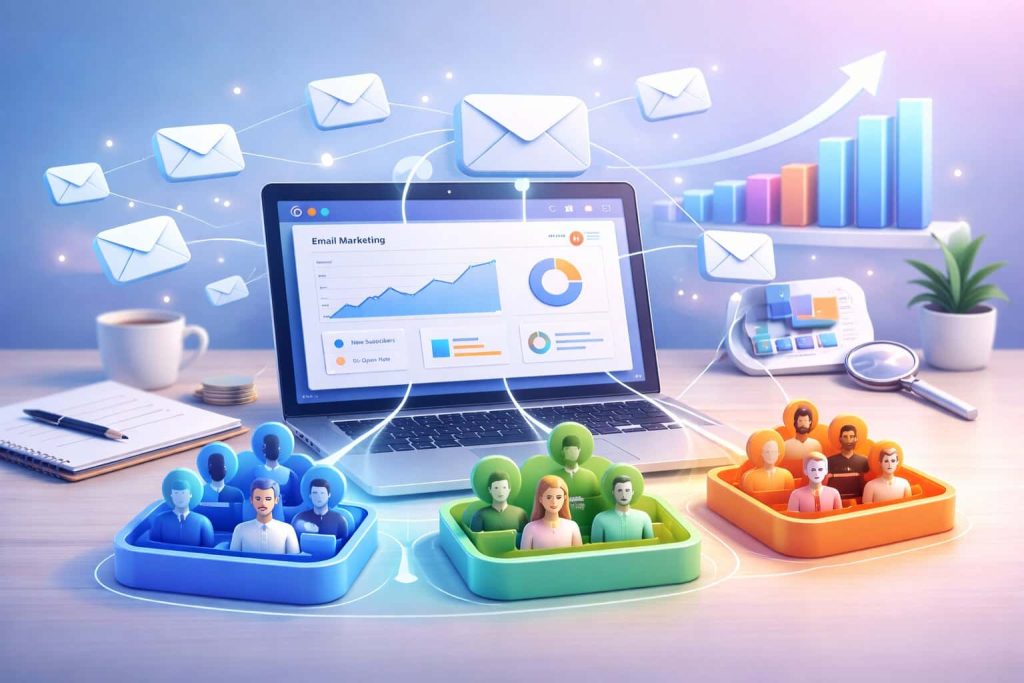
Email marketing remains one of the most powerful digital marketing channels in existence. For every dollar spent, businesses report an average return of $36 to $42, making it the highest ROI channel available to marketers. And yet, a surprising number of email programs are underperforming. Inboxes are more crowded than ever, attention spans are shorter, and subscribers have grown far more selective about what they choose to open. The average email open rate across industries hovers around 21 percent, meaning nearly four out of five emails sent go unread.
The root cause of low open rates is almost always the same: irrelevance. When subscribers receive emails that do not match their interests, needs, or stage in the customer journey, they stop opening them. Some unsubscribe. Others mark messages as spam. Over time, a disengaged list becomes a liability rather than an asset.
The solution is email segmentation. Rather than sending one generic message to your entire list, segmentation means dividing your subscribers into smaller, targeted groups and delivering content that speaks directly to each group’s specific interests and behaviors. Done well, segmented email campaigns generate dramatically higher open rates, click-through rates, and revenue. This article walks you through exactly how to build and execute an email segmentation strategy that moves the needle.
What Is Email Segmentation?
Email segmentation is the practice of dividing your email subscriber list into distinct subgroups, or segments, based on shared characteristics. These characteristics can be demographic (age, location, job title), behavioral (purchase history, email engagement, website activity), psychographic (interests, values, lifestyle), or lifecycle-based (new subscriber, loyal customer, lapsed buyer).
The defining feature of a segmented email strategy is intentionality. Instead of broadcasting a single message to everyone, you craft different messages for different audiences. A new subscriber receives a warm welcome series. A loyal customer receives an exclusive loyalty offer. A lapsed buyer receives a re-engagement campaign designed to win back their attention. Each person receives content that feels relevant to where they are in their relationship with your brand.
This stands in sharp contrast to the traditional “batch and blast” approach, where one email goes to everyone on the list regardless of their interests or history. Batch and blast emailing made sense in the early days of email marketing when lists were smaller and inboxes less crowded. Today, it is one of the fastest ways to erode subscriber trust and tank your open rates.
Why Segmentation Drives Higher Open Rates
The psychology behind segmentation is straightforward. People open emails they believe are worth their time. When a subject line reflects something a subscriber genuinely cares about, curiosity and relevance combine to compel an open. When a subject line feels generic or off-target, it gets ignored or deleted.
Segmentation also improves your sender reputation with inbox providers like Gmail and Outlook. These platforms monitor engagement signals: opens, clicks, replies, and whether emails are moved to spam. A highly engaged, segmented list sends strong positive signals, which means your emails are more likely to land in the primary inbox rather than the promotions folder or spam. The benefits of segmentation, in other words, are both immediate and compounding.
Types of Email Segmentation
Before building a segmentation strategy, it helps to understand the main categories of segmentation available to you. Most effective email programs use a combination of these approaches.
Demographic Segmentation
Demographic segmentation groups subscribers by personal attributes such as age, gender, geographic location, job title, company size, or income level. This is often the easiest type of segmentation to implement because demographic data is relatively straightforward to collect at the point of signup.
A clothing retailer might segment by gender to promote relevant collections. A B2B software company might segment by job title to ensure that messages about technical features go to developers, while business case messaging goes to decision-makers. A local restaurant chain might segment by city to promote location-specific offers. While demographic data alone rarely tells the full story of a subscriber, it is a useful first layer of personalization.
Behavioral Segmentation
Behavioral segmentation is arguably the most powerful form of segmentation because it is based on what subscribers actually do rather than who they are on paper. Behavioral data includes purchase history, browsing activity, email engagement patterns, product usage, and more. This type of data reveals intent and interest in ways that demographics cannot.
Common behavioral segments include:
- Frequent buyers who purchase regularly and respond well to new product announcements and loyalty rewards
- One-time buyers who need nurturing to convert into repeat customers
- Common behavioral segments include frequent buyers, one-time buyers, and cart abandoners who showed strong purchase intent but did not complete a transaction.
- High email engagers who open and click consistently, indicating strong interest
- Inactive subscribers who have not opened an email in 60 to 90 days and may need a re-engagement campaign
Behavioral segmentation allows you to meet subscribers at the exact moment of their highest interest and deliver a message that matches their current mindset. It is where segmentation begins to feel less like marketing and more like a well-timed conversation.
Psychographic Segmentation
Psychographic segmentation groups subscribers by their interests, values, attitudes, and lifestyle. This type of segmentation goes deeper than demographics or behavior and taps into the motivations that drive purchasing decisions. A fitness brand might segment subscribers who are interested in weight loss versus those focused on athletic performance. A travel company might separate budget travelers from luxury seekers.
Psychographic data is typically gathered through surveys, preference centers, or inferred from behavioral patterns. For example, if a subscriber consistently clicks on content about sustainable fashion, you can reasonably classify them in an eco-conscious segment and tailor future content accordingly.
Lifecycle Stage Segmentation
Lifecycle segmentation recognizes that subscribers have different needs depending on where they are in their relationship with your brand. A first-time subscriber needs onboarding and education. A repeat customer needs retention and loyalty content. A subscriber who has not purchased in six months needs re-engagement. Mapping your email content to these lifecycle stages ensures that each message is appropriate in tone, urgency, and offer.
The four most common lifecycle segments are new subscribers, active customers, at-risk subscribers, and churned or lapsed customers. Each requires a fundamentally different communication strategy, which is why lifecycle segmentation is one of the highest-impact approaches available.
How to Build Your Email Segmentation Strategy
Understanding segmentation types is one thing. Building a working strategy from scratch requires a clear, sequential process. The following six steps will take you from an unsegmented list to a fully operational segmentation program.
Step 1: Audit Your Current List and Data
Before you can segment, you need to understand what data you already have. Pull a report from your email platform and look at the fields available for each subscriber. Do you have location data? Purchase history? Engagement history? What gaps exist? This audit tells you which segmentation approaches are immediately available to you and which will require additional data collection.
Use this step to also clean your list. Remove hard bounces, obvious spam trap addresses, and duplicates. A clean list is the foundation of good deliverability and accurate segmentation.
Step 2: Define Your Segmentation Goals
Not all segmentation is created equal. The segments you build should align with specific business outcomes. Are you trying to improve overall open rates? Recover lapsed customers? Drive repeat purchases? Increase average order value? Define two or three primary goals before you start creating segments. This prevents you from building segments that are interesting academically but do not connect to measurable outcomes.
Step 3: Collect the Data You Need
Once you know what segments you want to build, identify any data gaps and create a plan to fill them. There are several practical approaches to collecting subscriber data:
- Signup forms: Add a small number of optional fields to your signup form, such as location, industry, or primary interest area. Keep it brief to avoid reducing conversion rates.
- Preference centers: Give subscribers a page where they can tell you what kinds of emails they want to receive and how often. This data is both voluntary and highly accurate.
- Post-purchase surveys: A short one or two question survey after a purchase can reveal a great deal about customer motivations and preferences.
- Progressive profiling: Rather than asking for everything upfront, gather information gradually across multiple interactions, adding to each subscriber’s profile over time.
- CRM and platform integration: Connect your email platform to your e-commerce store, CRM, or customer support tool to pull in behavioral and transactional data automatically.
Step 4: Build Your Initial Segments
Start with three to five well-defined segments rather than attempting to build a complex taxonomy on your first pass. Overly granular segmentation early on creates more operational complexity than it solves. A good starting set might include new subscribers (joined in the last 30 days), active buyers (purchased in the last 90 days), engaged non-buyers (open emails but have never purchased), and inactive subscribers (no opens in 90-plus days).
Document each segment clearly: what defines membership in the segment, what the messaging goal is for that segment, how often you will email them, and what success looks like.
Step 5: Create Tailored Content for Each Segment
This is where the investment in segmentation pays off. For each segment, think carefully about what that group actually needs to hear. What subject line would resonate with a brand-new subscriber who is still deciding whether your brand is worth their attention? It is different from the subject line that would excite a loyal customer who has purchased four times this year.
Tailor the subject line, preview text, email body, imagery, and calls to action to each segment. Even small adjustments, such as changing the offer or the opening line, can have a significant impact on open and click rates. The goal is for each subscriber to feel that the email was written specifically for them.
Step 6: Test, Measure, and Iterate
Segmentation is not a set-and-forget activity. After launching your segments, monitor performance closely. Track open rate, click-through rate, conversion rate, and unsubscribe rate by segment. Run A/B tests on subject lines within segments to identify what language resonates with each audience. Review segment membership monthly and update rules as subscriber behavior evolves. The most successful email programs treat segmentation as an ongoing practice of learning and refinement.
Writing Subject Lines That Maximize Opens by Segment
Subject lines are the single most important factor in whether an email gets opened. A perfectly crafted email inside a poorly written subject line will go unread. Segmentation gives you the foundation to write subject lines that are genuinely relevant, but you still need to translate that relevance into compelling copy.
Personalization Beyond the First Name
First-name personalization in subject lines was once a reliable open rate booster. Today, it is so common that it has lost much of its novelty. The more powerful form of personalization is contextual: referencing something the subscriber has done, expressed interest in, or is likely to care about based on their segment.
Subject lines that reflect behavior or context outperform generic ones consistently. Examples include messages like “Your cart is still waiting” for cart abandoners, “You might love these based on your last order” for repeat buyers, and “It has been a while, here is something special” for lapsed subscribers. These subject lines work because they signal relevance before the email is even opened.
Subject Line Approaches by Segment
Different segments respond to different psychological triggers. Here is how to think about subject line tone and approach by segment:
- New subscribers: Lead with curiosity, warmth, and a clear statement of value. They are still evaluating your brand.
- Active buyers: Use exclusivity, urgency, and insider language. They are invested in your brand and respond to being treated as insiders.
- Inactive subscribers: Be direct and empathetic. Acknowledge the gap and offer a compelling reason to re-engage.
- High-value customers: Use VIP language, early access offers, and personal touches that reward their loyalty.
Whatever the segment, avoid clickbait that does not match the email content. A misleading subject line may temporarily lift open rates, but it destroys trust over time and trains subscribers to be skeptical of your future emails.
Tools and Platforms for Email Segmentation
The right email marketing platform can make segmentation significantly easier by automating segment updates, integrating with external data sources, and providing the analytics you need to measure performance. Here is an overview of the leading platforms and what each does best.
Mailchimp is the most widely used email marketing platform and offers solid basic segmentation features. It supports demographic, behavioral, and engagement-based segmentation and is well-suited to small businesses and beginners. Klaviyo is the go-to platform for e-commerce businesses, offering deep integration with Shopify and other stores, real-time behavioral segmentation, and predictive analytics such as expected date of next purchase and lifetime value forecasting.
ActiveCampaign is a strong choice for businesses that need sophisticated automation alongside segmentation. It uses a tag-based system that allows for highly granular subscriber profiling and complex automated workflows. HubSpot’s email tools are tightly integrated with its CRM, making it the preferred choice for B2B companies that want to align marketing and sales data. Brevo, formerly known as Sendinblue, offers an affordable option with solid transactional and marketing email capabilities for growing businesses.
When evaluating platforms, prioritize the following features:
- Real-time segment updates that automatically move subscribers between segments as their behavior changes
- Native integration with your CRM, e-commerce store, or customer support tool
- A/B testing capabilities at the segment level
- Detailed analytics broken down by segment, not just overall list performance
Common Email Segmentation Mistakes to Avoid
Segmentation is a powerful strategy, but it is also one that is easy to get wrong. The following are the most common mistakes marketers make when building or running a segmented email program.
Over-segmentation is one of the most frequent pitfalls. In an attempt to be highly personalized, some marketers create dozens of micro-segments, each requiring its own content strategy, copy, and scheduling. The operational burden quickly becomes unsustainable, and the quality of content suffers. Start with a manageable number of segments and expand thoughtfully as your program matures.
Equally problematic is under-segmentation, or treating all subscribers as one group with minor surface-level differences. Sending the same email to a brand-new subscriber and a five-year loyal customer is a missed opportunity at best and a churn driver at worst. The investment required to build meaningful segments almost always pays for itself in improved engagement and revenue.
Another common mistake is building segments and then never updating them. Subscriber behavior changes constantly. Someone who was inactive last quarter may have made a purchase last week. Segments that are not updated in real time or at regular intervals become inaccurate and lose their effectiveness. Most modern email platforms offer dynamic segments that update automatically, which eliminates this problem when configured correctly.
Finally, many marketers collect more data than they ever use. Asking subscribers for extensive information at signup is a poor exchange if that data never informs the emails they receive. Only collect data you have a specific, near-term plan to act on. Over-collecting creates a false sense of preparedness while burdening subscribers with unnecessary form fields that reduce signup conversion rates.
Frequently Asked Questions
Q1. How many segments should I start with?
For most businesses, starting with three to five segments is the right approach. A practical starting set includes new subscribers, active buyers, engaged non-buyers, and inactive subscribers. This covers the most important stages of the subscriber lifecycle without creating unmanageable complexity. As you grow more comfortable with segmentation and gather richer data, you can introduce additional layers. The key principle is that each segment should have a clearly different message strategy. If two segments would receive the same email, they probably should not be separate segments.
Q2. Does email segmentation work for small lists?
Yes, and it can be especially effective for small lists. With a smaller audience, you often have a closer relationship with your subscribers and can make personalization feel more genuine. A list of 500 people can meaningfully benefit from separating new subscribers from returning customers, or buyers from non-buyers. Do not wait until your list reaches a certain size to start segmenting. The habits and infrastructure you build early will scale naturally as your list grows.
Q3. How often should I review and update my segments?
The ideal is real-time updates, which most modern email platforms support through dynamic segment rules. When configured correctly, subscribers automatically move into and out of segments as their behavior changes without any manual intervention. In addition to automated updates, a strategic review of your segment definitions and performance should take place at least quarterly. This is when you assess whether your segments are still aligned with your business goals, whether any new segment opportunities have emerged, and whether any existing segments should be consolidated or retired.
Q4. What data do I actually need to start segmenting?
You need less data than most people assume. Even with only the information your email platform collects by default, such as signup date, geographic location (inferred from IP address), and email engagement history (opens and clicks), you can build meaningful segments. Start with what you have. Engagement-based segmentation, which separates highly active subscribers from inactive ones, requires no additional data collection and can have an immediate impact on open rates and deliverability.
Q5. Can segmentation improve email deliverability?
Yes, significantly. By sending to your most engaged subscribers more frequently and suppressing inactive ones from certain campaigns, you maintain a strong average engagement rate across your sends. Inbox providers like Gmail use engagement signals to determine whether your emails land in the primary inbox, the promotions tab, or the spam folder. A list with consistently high open and click rates signals that your emails are valued, which improves your sender reputation and ensures better placement over time. Many deliverability experts recommend suppressing subscribers who have not engaged in 180 days as a minimum hygiene practice.
Q6. Is email segmentation the same as email personalization?
They are related but distinct concepts. Segmentation is the strategic process of dividing your list into groups so that different audiences receive different emails. Personalization is the tactical process of customizing individual elements within an email, such as a subscriber’s name, their most recently viewed product, or a recommendation based on their purchase history. The most effective email programs use both together: segmentation determines who receives which message, and personalization makes each message feel uniquely relevant to the individual reader. You can personalize without segmenting, but combining both produces the best results.
Conclusion
Email segmentation is not a luxury reserved for large marketing teams with enterprise budgets. It is a fundamental practice that any business, regardless of size or industry, can implement to dramatically improve the performance of its email program. The core insight is simple but powerful: people open emails that feel relevant to them, and segmentation is the mechanism that makes relevance possible at scale.
The businesses achieving the highest email open rates are not the ones with the largest lists or the biggest creative budgets. They are the ones that understand their subscribers well enough to send the right message to the right person at the right time. That understanding is built through thoughtful data collection, smart segmentation, and a commitment to continuous testing and refinement.
If you are just getting started, the most important step is to begin. Audit your current list, identify the three most meaningful subscriber groups you can distinguish today, and create a tailored message for each. The improvement in open rates will be visible almost immediately, and the momentum you build will make every subsequent layer of segmentation easier to add.
Email is still one of the most direct, personal, and high-value ways to communicate with your audience. Segmentation is what makes that communication feel like a conversation rather than a broadcast. Start building your segmentation strategy today, and your subscribers, and your metrics, will reflect the difference.