
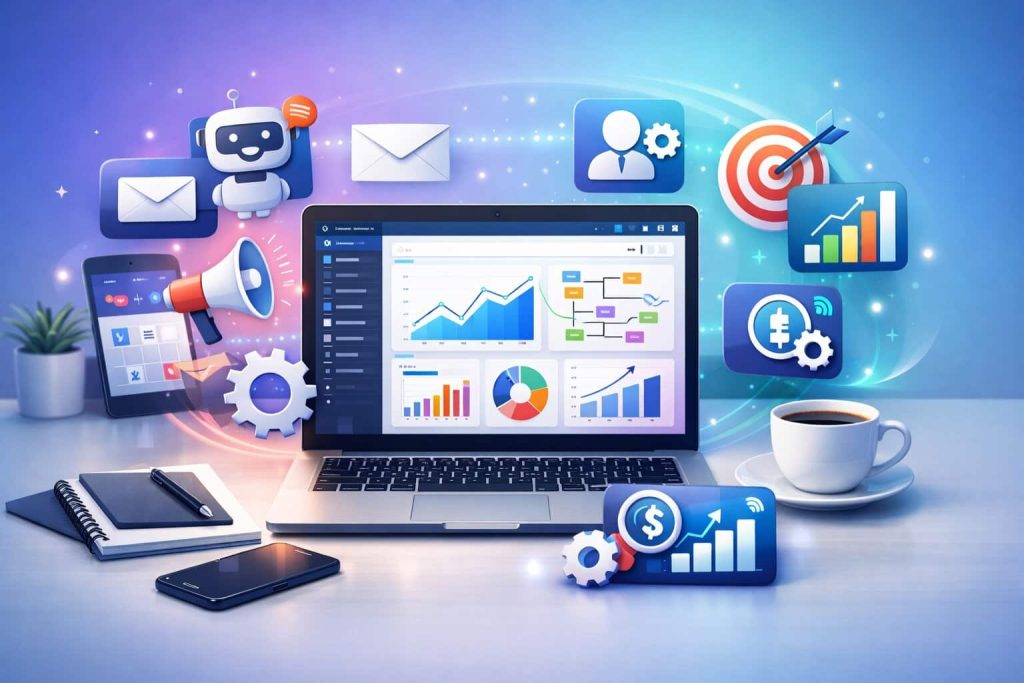
Running the marketing for a small business in 2026 looks nothing like it did even three years ago. The tools available today can write your blog posts, design your social graphics, manage your email sequences, answer customer enquiries around the clock, and analyse your ad performance, all at a price point that was reserved for enterprise software just a few years back. For small business owners who have been doing everything manually, or for those paying freelancers and agencies for tasks that AI can now handle reliably, this shift represents one of the most significant operational opportunities in a generation.
The challenge is not finding AI marketing tools. There are hundreds of them. The challenge is knowing which ones are actually worth your time and money as a small business, as opposed to the ones built for large marketing teams with dedicated specialists and unlimited budgets. This article cuts through that noise. It focuses specifically on the AI marketing tools that deliver practical, measurable value to businesses with lean teams, modest budgets, and no full-time marketing department. Every tool recommended here is accessible to a non-technical user, genuinely useful across a range of business types, and priced in a range that makes financial sense for a small operation.
Whether you are a solo founder, a local service business, or a small eCommerce brand, this guide will help you identify which AI marketing tools match your current needs, explain what each one actually does in plain language, and give you a clear starting point for integrating AI into your marketing workflow in 2026.
Why 2026 Is the Right Time to Adopt AI Marketing Tools
AI marketing tools are not new. Businesses have been using automated email sequences, basic chatbots, and algorithmic ad bidding for years. What changed significantly between 2023 and 2025 was the quality floor. The introduction of large language models capable of generating genuinely useful written content, combined with rapid improvements in image generation, automated design, and conversational AI, raised the baseline of what AI tools can produce from tolerable to genuinely good. Creative professionals exploring the best ai design tools for graphic designers learn more from designers-choice can now access AI-powered platforms that dramatically improve both speed and design quality.. For small businesses, this quality improvement is the difference between tools that save time and tools that save time while also producing results worth showing to customers.
The second shift is affordability. The AI capabilities that once lived inside expensive enterprise platforms have steadily migrated into consumer-priced tools. In 2026, a small business can access AI-powered content creation, SEO analysis, social media management, email automation, and customer communication tools for a combined monthly cost of under two hundred dollars. The equivalent human capability, a content writer, social media manager, SEO consultant, email marketer, and customer support agent, would cost well over two hundred thousand dollars per year in salaries. As a result, AI solution cost has become far more accessible for small businesses looking to scale efficiently. AI tools do not replace the judgement and strategy that human professionals bring, but they do handle a significant portion of the execution work that currently consumes most of a small business owner’s marketing time.
The Compounding Advantage of Early Adoption
There is also a compounding dynamic at play that makes 2026 a meaningful inflection point. The businesses that adopted AI marketing tools in 2024 and 2025 have spent the past year building their prompt libraries, training their brand voice configurations, and iterating on their automated workflows. Their content output is higher, their ad performance is tighter, and their response time to customer enquiries is faster. For businesses still running entirely manual marketing operations, the gap between AI-augmented competitors and themselves is widening. Starting now does not fully close that gap, but waiting longer makes it harder to close.
The Best AI Marketing Tools for Small Businesses in 2026
The tools below are organised by marketing function rather than ranked against each other, because the best tool for your business depends on where your biggest bottleneck currently sits. Read through all eight profiles, but pay particular attention to the categories where you are currently spending the most time or producing the weakest results.
01 ChatGPT (with GPT-4o) – AI Content and Copywriting
ChatGPT remains the most versatile AI marketing tool available in 2026, and for many small businesses it is the only one they truly need to start. Built on OpenAI’s GPT-4o model, it can write blog posts, ad copy, email sequences, product descriptions, social media captions, FAQ sections, and website copy from simple plain-language prompts. What has made it especially practical for small businesses since its major upgrades in 2024 and 2025 is its ability to follow detailed instructions about brand voice, target audience, and formatting, producing outputs that feel genuinely tailored rather than generic.
The Custom Instructions feature is where the real leverage lies for small business users. By spending thirty minutes writing a detailed description of your business, your typical customer, your brand tone, and the types of content you regularly produce, you create a persistent context that shapes every subsequent conversation. The result is outputs that need less editing and feel more like your brand, not like a generic AI writing assistant.
- Writes blog posts, ad copy, email sequences, social captions, and product descriptions from plain-language prompts
- Custom Instructions retain your brand voice and audience context across all sessions
- GPT-4o handles longer documents, multi-step instructions, and web browsing for current research
- Integrates with Zapier for workflow automation, such as triggering content generation from a spreadsheet entry
- Team plans allow shared custom GPTs and brand consistency across multiple users
Best for: Any small business owner creating regular written content who wants to dramatically accelerate output without sacrificing brand voice.
Pricing: Free tier available. ChatGPT Plus at $20 per month. Team plan at $25 per user per month.
02 Jasper AI – AI Content and Copywriting
Jasper AI is the premium option in the AI copywriting category, built specifically for marketing use cases rather than general-purpose conversation. Where ChatGPT is a versatile assistant, Jasper is a focused marketing content engine. Its Brand Voice feature, which can be trained on your existing website content, marketing emails, and published articles, produces outputs that genuinely sound like your company rather than a generic AI writing service. For small businesses that have invested in building a distinctive brand voice and cannot afford for AI to dilute it, this feature alone justifies the higher price point relative to free alternatives.
Jasper’s Campaigns feature is particularly useful for small businesses planning multi-channel marketing pushes. You describe your campaign goal, target audience, and core message in a single brief, and Jasper generates the full suite of campaign assets: email subject lines, ad copy variants, social captions, and a long-form blog post, all aligned to the same message and tone. The time saving compared to creating each asset individually is substantial.
- Brand Voice feature trained on your existing content ensures outputs match your established tone
- Marketing-specific templates cover Google Ads copy, Facebook Ads, email subject lines, and SEO meta descriptions
- Jasper Campaigns generates full multi-channel campaign assets from a single brief
- Plagiarism checker integrated to verify content originality before publication
- Team collaboration with role-based access for businesses working with contractors or part-time staff
Best for: Small businesses publishing high volumes of marketing content across multiple channels who need brand-consistent output at scale.
Pricing: Creator plan from $49 per month. Pro plan from $69 per month. Free 7-day trial available.
03 Buffer with AI Assistant – AI Social Media Management
Consistent social media presence is one of the most time-consuming marketing requirements for small businesses, and one of the first to suffer when the owner gets busy with operations. Buffer addresses this problem with a combination of scheduling, AI content generation, and analytics in a single affordable package. Its built-in AI Assistant removes the blank-page problem that makes social media posting feel laborious: type a topic, a URL, or a rough idea, and the assistant generates platform-optimised captions with appropriate hashtags and formatting for each channel.
What distinguishes Buffer in 2026 from earlier versions of the tool is its cross-platform intelligence. The AI does not simply copy the same caption across channels. It adapts the tone and format for each platform: more conversational for Instagram, more professional for LinkedIn, shorter for X, and more keyword-aware for Google Business Profile. For a small business managing four or five social channels, this automated adaptation eliminates the manual reworking that would otherwise eat thirty to forty minutes per post.
- AI Assistant generates platform-optimised captions, hashtag suggestions, and content variations from a topic or URL
- Scheduling across Instagram, Facebook, LinkedIn, X, TikTok, Pinterest, and Google Business Profile
- Start Page builds an AI-generated link-in-bio landing page automatically from your social profiles
- Analytics dashboard identifies best-performing content types and optimal posting times for your specific audience
- Repurposing tool converts blog posts or video transcripts into platform-specific social posts automatically
Best for: Small business owners managing their own social media who need simple, affordable scheduling combined with AI content generation.
Pricing: Free plan for up to 3 channels. Essentials from $6 per month per channel. Team plan from $12 per month per channel.
04 Semrush with AI Writing Tools – AI SEO and Keyword Research
Semrush has long been considered an enterprise SEO tool, but its 2024 and 2025 pricing tier restructuring and the integration of AI writing tools into its platform have made it genuinely viable for serious small business users. For a business investing in organic search as a primary acquisition channel, Semrush provides a level of keyword intelligence, competitive analysis, and content guidance that no other single tool in this price range matches. The AI enhancements are what make it particularly relevant here: the platform no longer just tells you what to write about, it increasingly helps you write it.
The Content Editor is where Semrush’s AI capability is most practical for small businesses. You enter your target keyword, and the editor pulls the top-ranking pages for that term, analyses their structure, word count, heading usage, and keyword distribution, and then provides a real-time content score as you write. The AI Outline Generator goes a step further, producing a data-driven article structure before you begin drafting, based on what is actually working in the current search results for your topic. The result is content that is optimised for both readers and search engines without requiring deep SEO expertise.
- Keyword Magic Tool with AI clustering identifies the highest-opportunity keyword groups for your niche
- Content Editor scores drafts against top-ranking pages and provides specific optimisation guidance in real time
- AI Outline Generator creates data-driven article structures based on competitor content analysis
- Site Audit with AI-prioritised recommendations helps non-technical users tackle the most impactful issues first
- Position Tracking monitors Google rankings for target keywords with weekly automated reporting
Best for: Small businesses investing in organic search and content marketing who want a single platform for keyword research, content creation, and performance tracking.
Pricing: Pro plan from $139.95 per month. Free limited account available. Trial recommended before committing.
05 Mailchimp with AI Features – AI Email Marketing
Email marketing remains one of the highest-return channels available to small businesses, and Mailchimp’s 2025 AI integration has made it significantly more accessible to business owners without a dedicated email specialist. The platform’s AI Content Optimizer automatically generates and tests multiple subject line and preview text variants, identifying which versions drive the highest open rates for your specific audience over time. This replaces the guesswork that characterises manual A/B testing for small businesses that rarely have enough list volume to reach statistical significance quickly.
The most impactful AI feature for day-to-day users is the AI campaign generator. You describe your goal in plain language, such as promoting a seasonal sale to past customers, and Mailchimp produces a complete email draft with design, copy, and a suggested send sequence. This is not a finished product that you publish without review, but it is a well-structured starting point that typically requires thirty minutes of editing rather than two hours of drafting from scratch. Combined with Send Time Optimisation, which uses machine learning to deliver each email when each individual recipient is statistically most likely to open it, these features meaningfully improve results without requiring marketing expertise.
- AI Content Optimizer generates and tests multiple subject line variants automatically for your audience
- Send Time Optimisation delivers emails at the individually optimal time for each recipient
- AI campaign generator creates full email drafts with design from a plain-language goal description
- Predictive Segmentation groups contacts by predicted purchase behaviour and engagement likelihood
- Journey Builder with AI suggestions recommends automation sequences based on your business type
Best for: Small businesses with an email list of any size who want to improve open rates, automate follow-up sequences, and personalise communication without a dedicated email specialist.
Pricing: Free plan up to 500 contacts. Essentials from $13 per month. Standard from $20 per month, which includes most AI features.
06 Canva with Magic Studio – AI Visual Design
For the majority of small businesses, visual content production, social graphics, presentation decks, email headers, ad creatives, and short-form video, has historically required either expensive software, design skills, or both. Canva’s Magic Studio, which encompasses the platform’s full suite of AI design tools, changes that equation significantly. In 2026, a business owner with no design background can produce professional-quality visual content across every major format in the time it would previously have taken a designer to open a brief.
The Magic Design feature is the most practical entry point. You describe what you need in plain text, and the system generates multiple on-brand layout options using your uploaded brand kit, pulling in your logo, brand colours, and fonts automatically. For social media specifically, the AI resizes and reformats any design for every platform simultaneously, eliminating the tedious process of manually adjusting dimensions for each channel. The Text to Image tool generates custom AI photography and illustration for any creative without stock photo licensing concerns, which removes both the cost and the homogeneous look that stock imagery creates.
- Magic Design generates on-brand social graphics, presentations, and marketing materials from a text prompt
- Brand Kit locks in logo, colours, and fonts so all AI-generated designs are automatically on-brand
- Text to Image creates custom AI photography and illustration without stock licensing concerns
- Magic Video generates short-form social content from a script or URL with automatic captions
- One-click resize reformats any design for every platform and format simultaneously
Best for: Small businesses needing a consistent flow of visual content for social media, ads, presentations, and email without hiring a graphic designer.
Pricing: Free plan with limited Magic Studio features. Canva Pro at $15 per month includes full Magic Studio access.
07 Surfer SEO – AI Content Optimisation
Where Semrush provides broad SEO capability across keyword research, site auditing, and competitive intelligence, Surfer SEO is a specialist tool focused almost entirely on the process of creating content that ranks. It is the right choice for small businesses that are already publishing blog content and want a data-driven system for ensuring that content performs in organic search, rather than hoping that well-written articles will naturally find their way to page one.
The practical core of Surfer SEO for small businesses is the Content Editor. After entering your target keyword, the editor presents a real-time optimisation score as you write, based on analysis of the top-ranking pages for that term. It specifies the recommended word count, the headings structure that correlates with first-page rankings, the natural language terms that should appear in the copy, and the internal linking opportunities. Following these guidelines does not guarantee first-page rankings, but it does ensure that your content matches the structural and semantic patterns that Google has already validated by ranking similar content highly.
- Content Editor scores drafts in real time against the top-ranking pages for your target keyword
- AI Outline Generator creates a data-driven article structure from competitor analysis before writing begins
- Topical Map identifies all the content your site needs to build topical authority in your niche
- Surfer AI writes full SEO-optimised articles with one-click WordPress publishing
- SERP Analyser breaks down the exact factors correlating with first-page rankings for any keyword
Best for: Content-focused small businesses publishing blog articles regularly who want a data-driven approach to SEO optimisation.
Pricing: Essential plan from $99 per month. Scale plan from $219 per month. Free 7-day trial available.
08 Tidio with Lyro AI – AI Customer Communication
Most discussions of AI marketing tools focus on content creation and advertising, but customer communication is where AI can have the most immediate and measurable impact on revenue for small businesses with active websites. Tidio’s Lyro AI chatbot handles up to 70 percent of routine customer enquiries automatically using your existing website content, FAQs, and product information as its knowledge base. For a small business owner who currently spends two or three hours per day answering the same questions about pricing, availability, and delivery, this alone can be transformative.
The lead generation application is equally compelling. Lyro AI engages website visitors proactively, asks qualifying questions, and captures contact details for follow-up, functioning as a round-the-clock sales development representative that never misses a visitor and never takes a day off. The AI Lead Qualifier feature goes beyond simple chat collection; it can identify high-intent visitors based on the pages they have visited and the questions they are asking, and flag them for immediate follow-up. For eCommerce businesses, the abandoned cart recovery automation triggers personalised messages when visitors leave without purchasing, directly recovering revenue that would otherwise be lost.
- Lyro AI chatbot handles up to 70 percent of customer enquiries automatically from your existing content
- AI Lead Qualifier engages visitors, asks qualifying questions, and captures contact details automatically
- Live chat with AI-assisted reply suggestions helps human agents respond faster with relevant answers
- Abandoned cart recovery automation sends personalised messages to eCommerce visitors who leave without buying
- Integrates with Shopify, WooCommerce, WordPress, and major CRM platforms
Best for: Small businesses with active websites receiving regular enquiries, particularly eCommerce stores and service businesses wanting to convert more visitors into leads.
Pricing: Free plan with 50 Lyro AI conversations per month. Lyro AI plan from $29 per month. Growth plan from $59 per month.
09 Renderforest AI Music Video Generator – AI Video Content Creation
Renderforest AI Music Video Generator is the most accessible solution in 2026 for small businesses, musicians, and content creators who need professional video content without a video production team. Where most AI video tools require you to start from footage or stock clips, Renderforest works directly from your music and a text prompt. Upload your track, describe the visual direction you want, and the platform analyses the audio’s tempo, mood, and lyrical content to generate a fully synchronised music video from scratch. For small businesses running promotional campaigns around branded audio, product launches with a musical identity, or social media content that needs to stand out, this automation removes the most technically demanding part of video production entirely.
What makes Renderforest particularly compelling for business use is the all-in-one workflow. The AI does not hand you a raw clip and leave the rest to you. Generated scenes can be refined directly inside the same editor, timing and visuals adjusted without rebuilding from scratch, and the finished video exported in the correct format and aspect ratio for every platform where you intend to publish. The multiple AI model options – including Seedance 2.0, Kling 3.0, and Renderforest’s own fast model – give users meaningful control over visual style and generation quality within a single subscription, rather than requiring separate tools for different creative outcomes.
- Beat-synced video generation analyses your track’s tempo, mood, and lyrics to create story-driven visuals automatically from a prompt and audio upload
- Multiple leading AI models available within one subscription, including Seedance 2.0, Kling 3.0, and Renderforest 1.0, giving control over visual style and quality
- All-in-one editor allows scene refinement, timing adjustments, and visual fine-tuning after generation without switching tools
- Vertical 9:16 and horizontal 16:9 export formats ready for YouTube, TikTok, Instagram Reels, and Spotify Canvas
- Reference image upload lets you incorporate your logo, product visuals, brand characters, or location imagery into AI-generated scenes
- Commercial usage rights included on paid plans for publishing, monetising, and distributing across any platform
Best for: Musicians, content creators, and small businesses producing regular social media video content who need professional, beat-matched visuals without video editing skills or production budgets.
Pricing: Free plan available with watermark. Lite plan from $9 per month. Pro plan from $19 per month. Business plan from $29 per month, billed annually.
How to Choose the Right AI Marketing Tools for Your Business
With eight strong options across six marketing functions, the question of where to start can feel as overwhelming as the problem you are trying to solve. The most useful framing is to treat this as a bottleneck problem rather than a feature comparison exercise. Every small business has one or two marketing functions that currently consume disproportionate time, produce inconsistent results, or represent a clear gap relative to what competitors are doing. The right starting point is the tool that addresses the most painful of those bottlenecks, not the one with the most impressive feature list.
Budget is the second constraint to be honest about. If you are starting with a tight budget, the combination of ChatGPT Plus at twenty dollars per month and Canva Pro at fifteen dollars per month gives you AI-powered content creation and visual design for thirty-five dollars per month combined. That is a highly capable starting stack that addresses the two most universal marketing bottlenecks for small businesses. From there, you can add specialist tools as budget allows and as your familiarity with AI-assisted workflows grows.
Matching Your Biggest Bottleneck to the Right Tool
The table below is a quick reference for matching your primary marketing challenge to the most relevant tool. Use your answers to determine where to start, not as a prescription for your eventual tool stack.
| Your Biggest Bottleneck | Start With This Tool |
| Writing content (blogs, ads, emails) | ChatGPT Plus (free to start) or Jasper AI (brand-focused) |
| Social media posting and captions | Buffer with AI Assistant |
| Getting found on Google | Semrush (comprehensive) or Surfer SEO (content-focused) |
| Email marketing and automation | Mailchimp with AI Features |
| Visual design and social graphics | Canva Magic Studio |
| Converting website visitors to leads | Tidio with Lyro AI |
| Best all-in-one start on a budget | ChatGPT Plus + Canva Pro (under $35/month combined) |
Avoiding the Overadoption Trap
The most common mistake small business owners make when exploring AI marketing tools is attempting to implement too many at once. Each tool has a learning curve. Each one requires configuration time to produce outputs aligned to your brand. Each one needs to be tested against your specific workflow before you can evaluate its true value. Attempting to adopt five tools simultaneously typically results in using all of them at ten percent of their capability and none of them effectively. A single tool, used consistently and skillfully for sixty to ninety days, will deliver more measurable value than a sprawling tech stack used superficially.
Getting Started: A Practical First 30 Days with AI Marketing Tools
Knowing which tool to adopt is only half the challenge. The other half is actually building the habit of using it consistently and giving it enough time to demonstrate its value. The following phased approach is based on what works for small business owners who have limited time for learning new software and need to see results quickly to justify the investment.
Week One: Foundation
In the first week, the goal is to get the tool configured correctly and to complete one real, usable piece of marketing work with it. Do not spend the week watching tutorial videos. Watch one overview video, read the getting-started guide, and then immediately apply the tool to an actual task on your to-do list. For ChatGPT, that might mean writing next week’s email newsletter. For Buffer, it might mean scheduling a full week of social posts. The experience of using the tool for real work, not hypothetical examples, is what accelerates the learning curve.
Weeks Two and Three: Consistent Integration
The second and third weeks are where the real learning happens. Use the tool for every applicable task without reverting to your previous manual process, even if the outputs initially need more editing than you expected. This is the phase most people rush through, and it is the most important one. The temptation to revert to familiar methods when a tool produces an imperfect output is strong, but the outputs improve significantly as you develop the skill of writing better prompts and configuring the tool more precisely for your needs.
Keep a simple running note of three things during this period: tasks where the tool saved you meaningful time, outputs that needed minimal editing, and areas where the tool consistently fell short. This record becomes the evidence base for your evaluation at the end of the month.
Week Four: Evaluate and Expand
At the end of the first month, compare your marketing output metrics to the previous month. Did you publish more content? Did your email open rates improve? Did you save meaningful time that you redirected into higher-value work? If the answer to at least two of these questions is yes, commit to the paid plan if you are on a trial and begin identifying the second bottleneck to address. If the results are disappointing, diagnose whether the issue is the tool itself or the way you are using it before concluding it is not worth pursuing.
Frequently Asked Questions
Do I need any technical skills to use AI marketing tools as a small business owner?
No technical background is required for any of the tools profiled in this article. All are designed for non-technical users with interfaces built around plain-language prompts and straightforward point-and-click configuration. The primary skill you will develop is writing clearer, more specific prompts, which most users find comes naturally within one to two weeks of regular use. If you can write an email, you have the core skill required to use these tools effectively.
Are AI marketing tools worth the cost for a very small or solo operation?
The economics are actually most compelling at the smallest scale. A solo operator who saves ten hours per week of manual marketing work using AI tools is reclaiming time worth far more than any subscription cost. Most tools offer free tiers or trials that allow meaningful testing before any financial commitment. Frame the decision as a staffing efficiency question: what would it cost to hire someone to do the same work, and does the tool cost less than that?
Will AI-generated content hurt my search rankings with Google?
Google’s official position is that it evaluates content quality, usefulness, and accuracy regardless of whether it was AI-assisted. Well-edited, accurate, and genuinely helpful AI-generated content is not penalised. The risk comes from publishing unedited, generic, or factually inaccurate content at volume. Use AI to accelerate the drafting process, but always review, add original insight, and verify any factual claims before publishing. The quality of the editing is what determines the SEO outcome, not the tool used to produce the draft.
How many AI marketing tools should a small business use at once?
Start with one. Add a second only after the first is fully embedded in your workflow and delivering measurable value. The most common failure mode with AI tool adoption is spreading attention across too many tools simultaneously, using each superficially rather than developing real proficiency with any of them. A focused stack of two to three tools used consistently will outperform a ten-tool stack used occasionally. More tools mean more learning curves, more subscription costs, and more cognitive overhead managing them all.
What is the best AI marketing tool to start with in 2026?
For most small businesses, ChatGPT Plus at twenty dollars per month is the highest-leverage starting point because it addresses the widest range of marketing tasks from a single interface. If content creation is not your primary bottleneck, choose the tool that matches your most pressing challenge directly: Buffer for social media, Mailchimp for email, Canva for design, or Tidio for customer conversion. The best tool is always the one that addresses your specific constraint, not the one with the most features.
Can AI tools replace a marketing agency or freelancer for a small business?
For execution tasks such as content drafting, post scheduling, basic SEO optimisation, and email automation, AI tools can handle a significant portion of what a junior agency or freelancer would provide. For strategy, brand positioning, creative direction, and interpreting complex performance data, human judgement remains essential. Many small businesses find a hybrid model most effective: AI handles execution volume while a part-time consultant or freelancer provides strategic oversight and quality control at a fraction of the cost of full agency engagement.
How do I measure whether an AI marketing tool is actually working?
Measure the same KPIs you tracked before adopting the tool. Content publishing frequency, email open and click rates, organic search traffic, social engagement, and lead volume are all trackable baselines. Document your current numbers before you start, then compare them at 60 days post-adoption. Time savings are an equally legitimate ROI measure: track hours spent on marketing tasks before and after to calculate the true value being generated relative to the subscription cost.
Conclusion
The tools profiled in this guide are not futuristic technology that requires specialist knowledge to operate. They are practical, affordable, and available today to any small business owner willing to invest the time to learn them. The businesses using them are producing more content, responding to customers faster, running more effective email campaigns, and getting found more readily in search, often with a single person doing the work that previously required a full team or an expensive agency.
The decision is no longer whether AI marketing tools are ready for small businesses. They are. The decision is which bottleneck to address first and how quickly to build these tools into your standard marketing workflow. Start with one tool, commit to sixty days of consistent use, and measure the results honestly. That process, repeated with each subsequent tool, is how small businesses in 2026 are building marketing operations that compete effectively with companies that have resources far beyond their own.
The gap between AI-augmented and manually-operated small business marketing is real and widening. The tools to close it are accessible, affordable, and ready to use today.